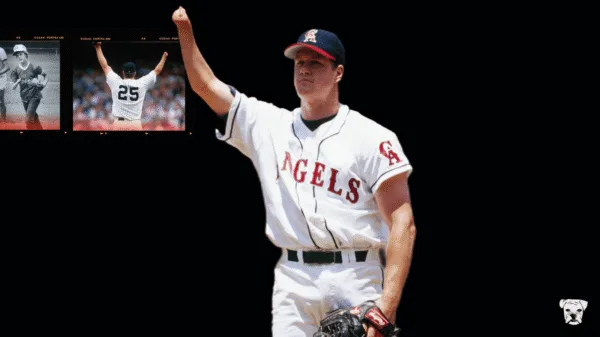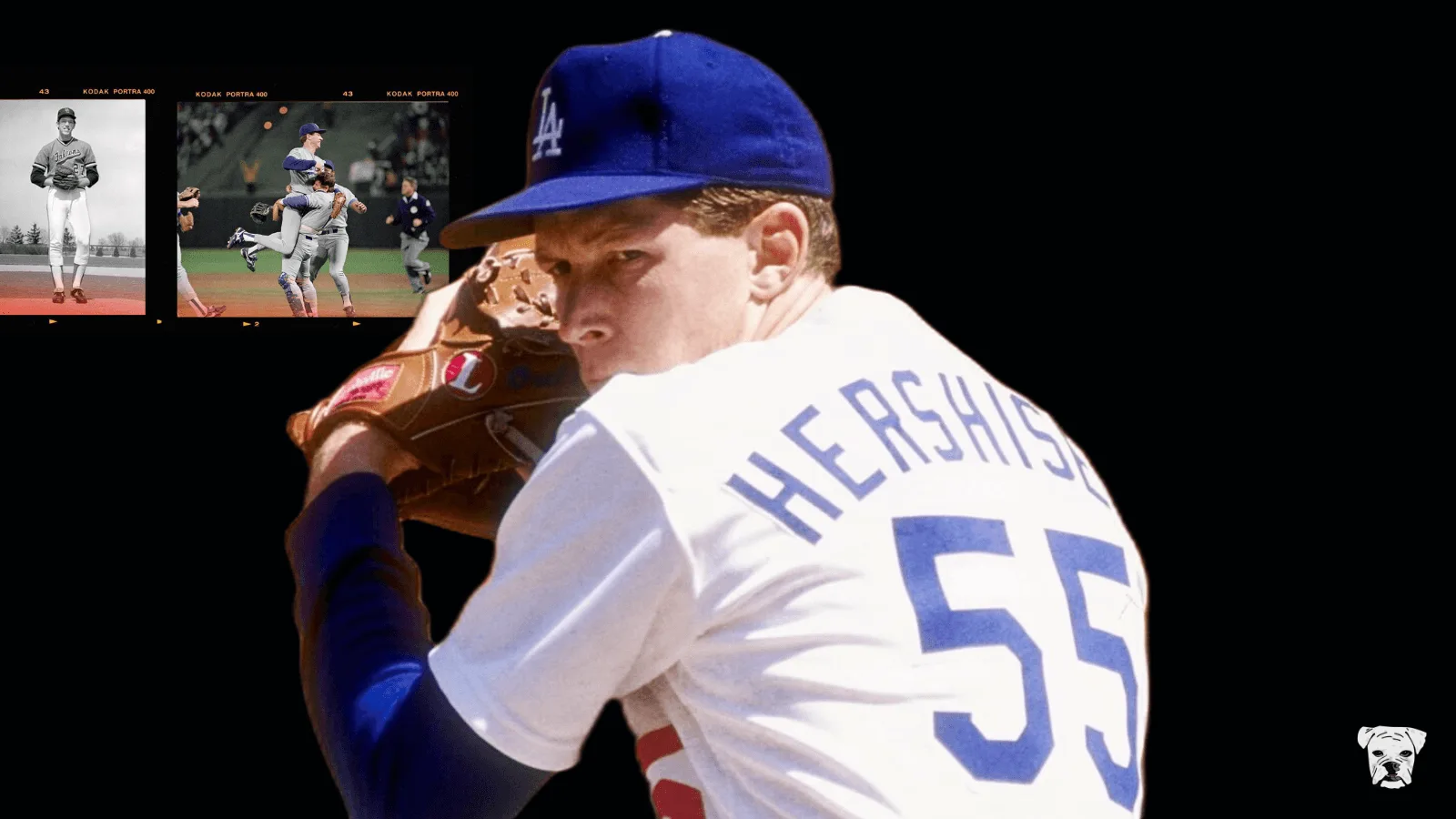
He may have stood 6’3” and weighed 190 pounds, but Orel Hershiser looked more like an insurance salesman than a guy who’d make you look silly at the plate whiffing on a sinker.
And yet he managed to set one of baseball’s most unbreakable records with 59 consecutive scoreless innings.
Fittingly, Hershiser’s path to greatness wasn’t a typical one. Long before he became a World Series Champion and MVP, a NL Championship Series MVP, a Cy Young winner, a Gold Glove award winner, and a three-time All-Star, the righty from Buffalo, New York, almost walked away from the game.
Born on September 16th, 1958, Orel Leonard Hershiser IV was one of Orel and Mildred Hershiser’s four children.
After bouncing from New York to Detroit to Toronto and finally settling in Cherry Hill, New Jersey, all by the age of 12, the Hershiser children had experienced a lot of change, but were raised with a strong work ethic.
After playing Little League in Canada, Hershiser tried out for the varsity team at Cherry Hill High School East, only to be placed on the freshman squad.
As a sophomore the following season, he found himself on JV.
It wasn’t until his junior year that Hershiser got his shot at playing on the varsity team. Taking out two years of pent-up anger and frustration, he set a Cougars record, striking out 15 batters in a single game.
Despite his performances in his final two high school seasons, which included a spot on the All-Conference team and among the leaders in career winning percentage and strikeouts, few thought of him as a future major leaguer due to his slight frame and lack of power.
Bowling Green State University presented Hershiser with a partial scholarship, which, while better than nothing, was certainly not what an All-Conference pitcher was hoping for.
Yes, it was a Division I school, but the Falcons were a mid-major program, and as a freshman, Hershiser found himself on the bench more than he did on the mound.
Uninspired both on and off the field, he found himself academically ineligible, with a 1.2 GPA.
Discouraged, he left campus and hitchhiked the more than 500-mile, 8-hour ride home from Ohio to New Jersey.
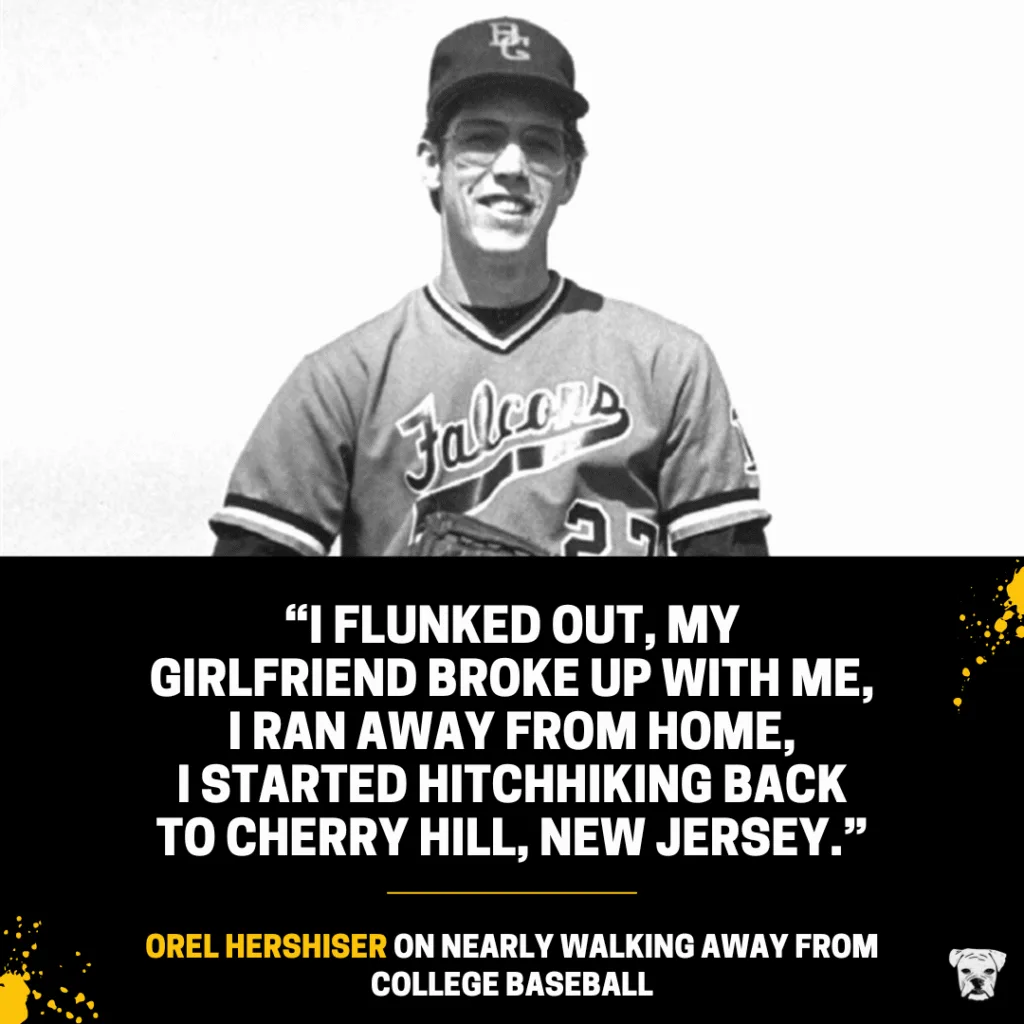
“I flunked out, my girlfriend broke up with me, I ran away from home, I started hitchhiking back to Cherry Hill, New Jersey, where I went to high school,” he recounted in a graduation speech at Bowling Green.
“[I] skipped finals week, ran out of money in Pennsylvania, my parents had to Western Union me some money so I could take a bus home to Michigan where they lived. And when I got there, they were kinda mad.”
“My mom didn’t even greet me at the door. My dad said, ‘You have put your mother through a ringer.’”
Ultimately, they gave him two choices: go to work, or try to get back into school.
He took door number two, and he enrolled in summer classes at Bowling Green to improve his grades. When he wasn’t in class, Hershiser found himself working at his father’s paper company, while also hitting the weights.
Putting on some size and strength, Hershiser added up to 5 miles per hour on his fastball. Just as he found in his junior year of high school, his third year of college brought him more attention.
In what would amount to his only full season at Bowling Green, Hershiser went 6-2 with a 2.25 ERA. He made the All-Mid-American Conference All-Star Team and threw a no-hitter against Kent State, despite striking out just two batters.
Years later, Hershiser reflected on his teenage years.
“A lot of the difficulty in being young, scrawny, not hitting my growth spurt and strength until I was 20, 21, I think it helped. It built my work ethic, it built my passion and love for the sport.”
When the 1979 MLB Draft rolled around, Hershiser answered a phone call. The voice on the other end told him that the San Diego Padres had selected him in the 2nd round.
It turned out to be a prank from his fraternity brothers.
He had to wait a while longer for the LA Dodgers to call his name, taking a chance on the Falcons’ pitcher in the 17th round, selecting him 440th overall.
If one were to read the pre-draft scouting report, they would see such notes as “poor control”, “a weak fastball”, “too skinny”, and “didn’t grip the ball properly.”
After four and a half years in the Dodgers’ minor league system, Hershiser made his debut in 1983 and became a full-time starter a season later.
It was at this point that legendary Dodgers manager Tommy Lasorda gave Hershiser the nickname “Bulldog”. Originally, he didn’t care for the tag, but Lasorda believed that his young pitcher had the fierce determination to make up for what he lacked in raw physical talent.
“You’ve got good stuff. If you didn’t, I wouldn’t have brought you up,” Lasorda told his future star.
While he may not have looked intimidating on the mound, his intelligence, competitive hunger, and ability to control the ball justified Lasorda’s reasoning.
Sporting a winning record in eleven of his thirteen seasons with the Dodgers, including an impressive 19-3 record in 1985, it was the 1988 season that officially put Hershiser on the map.
Going 23-8 with a 2.26 ERA, he won the NL Cy Young Award and made his second of three straight All-Star Game appearances. But it wasn’t just the win-loss record that stood out.
Starting on August 30th, Hershiser began a streak that’s stood the test of time to this day, pitching 59 consecutive scoreless innings, breaking Don Drysdale’s 20-year-old record that many believed was untouchable.
Once Hershiser had tied Drysdale’s record, he asked Lasorda to take him out of the game, but was persuaded to stay in.
When Drysdale heard of the request, he said, “I would have gone out there and kicked him in the rear.”
If that wasn’t impressive enough, Hershiser found an even higher gear in the postseason.
Under the brightest of lights, the Dodgers’ right-hander dominated. Starting five of six games, Hershiser went 3-0, throwing three complete games with an ERA of 1.05.
Outfielder Kirk Gibson had the highest of praise for his teammate, “As long as we all live, none of us will ever see any pitcher accomplish what Orel has done; he’ll go down in history.”
Two years later, Hershiser found himself on the sidelines for all but one game as the result of a torn labrum in his pitching arm. While he wasn’t as dominant on the mound, he put together a surprising season at the plate, batting .356 in 83 plate appearances and winning the 1993 Silver Slugger award.
A year later, he pitched his final season in Los Angeles.
Signing with Cleveland as a free agent, Hershiser played a major role in helping the Indians to two World Series trips in three years, winning ALCS MVP in 1995.
After leaving Cleveland following the ’97 season, Hershiser signed with the San Francisco Giants in 1998, the same team he’d battled for years while wearing Dodger blue.
In his lone season with the Giants, he went 11-10 with a 4.41 ERA, showing that while he wasn’t the dominant force of his youth, he could still be effective.
He moved to the New York Mets in ’99, where he went 13-12 with a 4.58 ERA in 32 starts. By that point, Hershiser had adapted his game, adding a slider to compensate for diminishing speed and power while relying even more heavily on location and intelligence.
After the 1999 season, Hershiser returned to his home away from home, signing a one-year contract to return to the Dodgers. He started the home opener on April 14th, 2000, against the Reds, allowing just one run in six innings.
His final MLB appearance came on June 26th, 2000, against the Padres, at 41 years old – still grinding, still competing.
As to why Orel Hershiser isn’t in the Hall of Fame? It’s been over 24 years since he retired, and the answer comes down to what always seems to matter most when it comes to the voting committee: numbers.
A 204-150 record, 3.48 ERA, and 56.0 WAR are solid but not spectacular when compared with the all-time greats. His peak was amazing, arguably as good as anyone’s in the late 1980s, but it was brief.
The shoulder injury that cost him most of 1990 robbed him of what might have been several more elite seasons. Hall of Fame voters gave him just 11.2 percent of the vote in 2006, and he dropped off the ballot entirely after receiving only 4.4 percent in 2007.
He’s appeared on the Today’s Game Era Committee ballot multiple times since 2017 but has received fewer than five votes each time.
And yet, there’s something about Hershiser’s story that goes beyond the stat sheet. He holds one of baseball’s most unbreakable records. He dominated on the biggest stages. Most importantly, he proved that the kid who couldn’t make varsity, who hitchhiked home ready to quit, who got picked 440th in the draft, could become a legend.
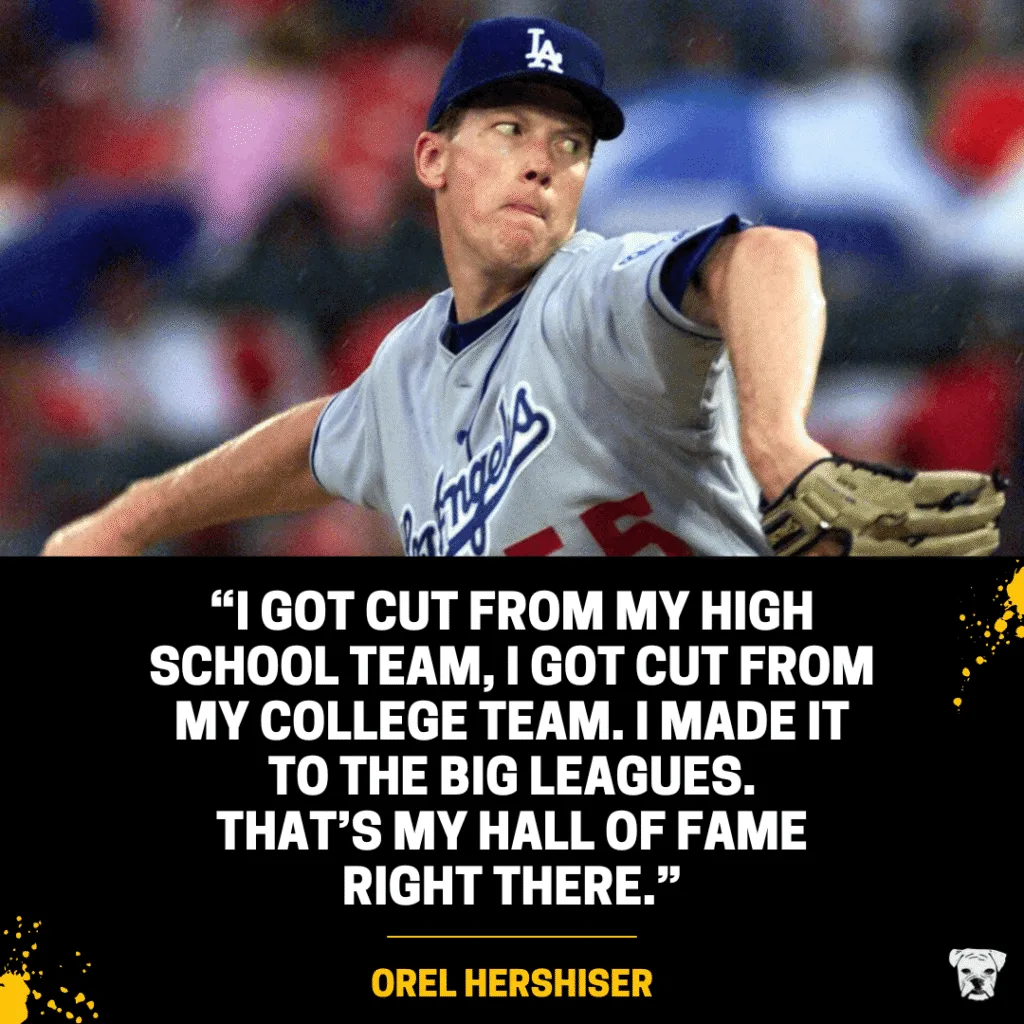
“I got cut from my high school team, I got cut from my college team,” Hershiser said.
“I made it to the big leagues. That’s my Hall of Fame right there. Everything after that was a great team accomplishment.”