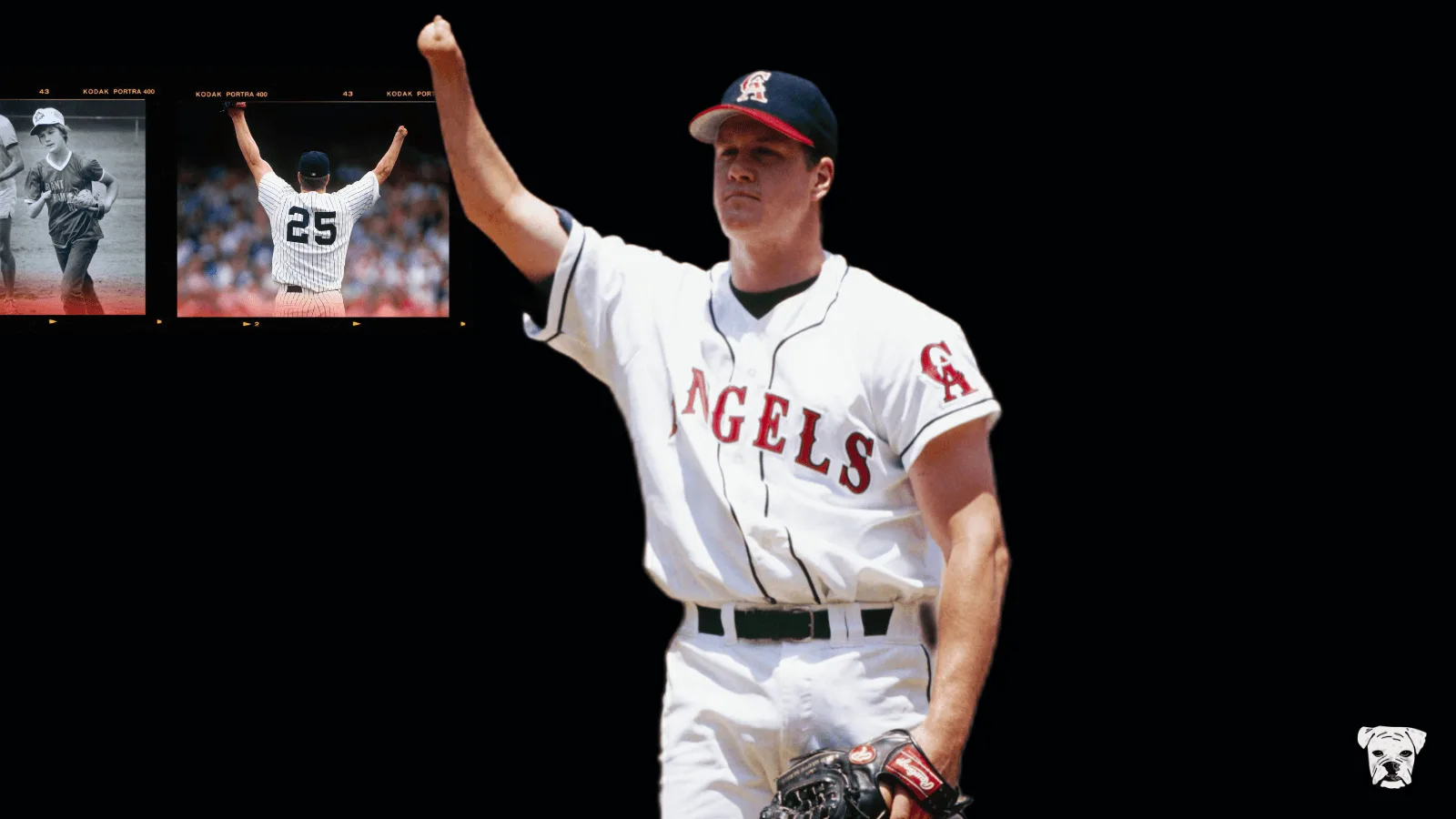
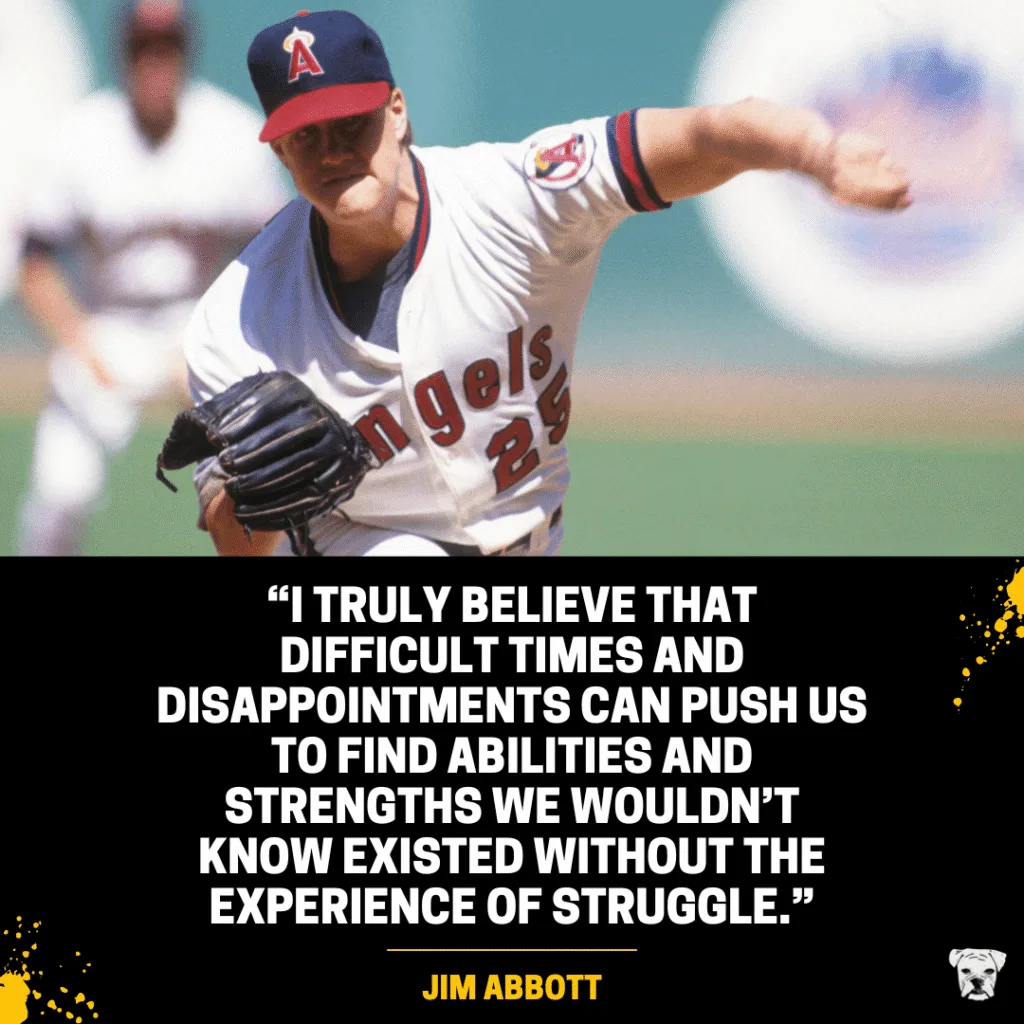
“I truly believe that difficult times and disappointments can push us to find abilities and strengths we wouldn’t know existed without the experience of struggle.”
Countless young baseball players dream of making it to the big leagues. Very few of them actually do.
Those who might often travel through years in the minor leagues, hoping for a call-up. Jim Abbott never played a single inning of minor league ball.
Not a single Double-A appearance, not even a game in Triple-A. He went straight from the Olympic mound to being part of a rotation in the big leagues.
Four years later, he served up a no-hitter at the famed Yankee Stadium.
Talk about making dreams into reality. And he did it all with one hand.
James Anthony Abbott was born on September 19th, 1967, without a right hand. Growing up in Flint, Michigan, Jim’s parents, Mike and Kathy, were both young, just out of high school, and tried to treat him like a normal kid, despite the obvious difference.
While they originally wanted to try and steer him towards soccer, which they thought would be easier on his body, Jim wanted to play baseball like every other kid in his neighborhood.
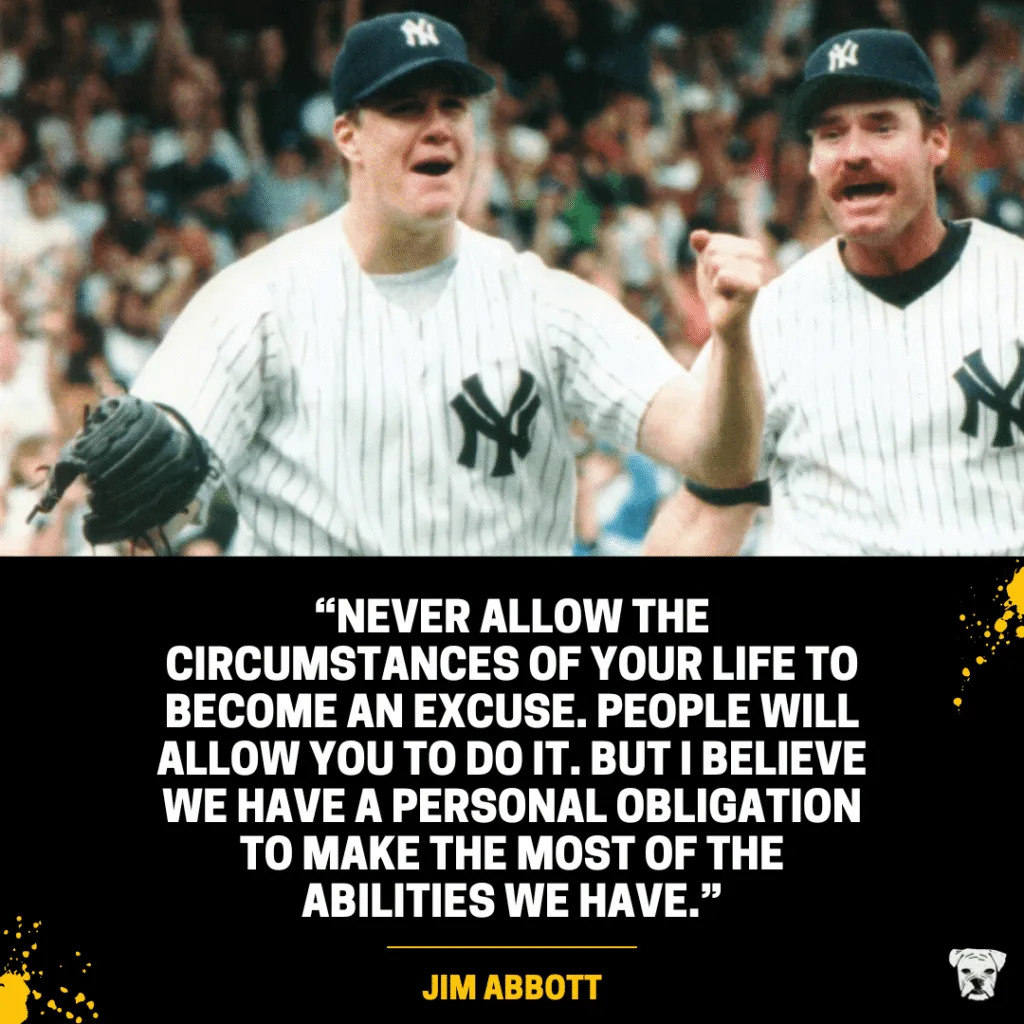
“Never allow the circumstances of your life to become an excuse,” Abbott said later.
“People will allow you to do it. But I believe we have a personal obligation to make the most of the abilities we have.”
By allowing the ball to slip out of his glove, dropping the glove, and then throwing with his left hand, Jim and his dad figured out how he could handle a ball and glove with just one hand.
When Mike was busy, and younger brother Chad didn’t want to, and there was nobody else to play with, Jim developed his own set of drills, including one in which he stood in front of a brick wall and then fired a rubber ball at it, catching the rebound bare-handed.
Repeating the drill over and over, he learned how to field with a glove tucked under the stub of his right arm and then transfer it back to his throwing hand fast enough to make a play. As he got better, he moved closer to the wall, forcing the transfer time to happen quicker with each rep.
This drill would lay the foundation for his entire professional career.
“I benefitted from tremendous encouragement as a kid,” Jim wrote in his book, Imperfect: An Improbable Life.
“So many people reached out to me, helped me, and believed in me when I didn’t always believe in myself.”
By the time Jim reached his junior year of high school, he’d grown to stand 6’4” and weighed 175 pounds and had developed into one of the best young athletes in the state. As the quarterback for the Flint Central Indians (now Phoenix), he led his team to the state semi-finals, throwing four touchdowns in his final game.
On the mound, he was throwing in the low 90s with a nasty slider. He even found success at the plate, batting left-handed with the bat wedged between his hand and right forearm, hitting .427 and 7 home runs in his senior season.
“In my 13 years of high school coaching, he’s the best all-around athlete in baseball I’ve ever seen,” Bob Holec, Abbott’s high school coach, admitted. “His greatest attribute is that where most people think of the disability, he makes you aware of his ability.”
In the summer of 1985, Jim had caught the eye of Toronto Blue Jays scout Don Welke.
Recommending that the team take the left-handed pitcher, the Jays selected Abbott in the 36th round of the 1985 MLB Draft. Although he was presented with a $50,000 signing bonus, he decided against moving north across the border and instead went to Ann Arbor to suit up for Michigan.
During his three seasons with the Wolverines, Abbott’s story changed from being remarkable to being dominant.
Posting a 26-8 record with a 3.03 ERA, he helped Michigan to a pair of Big Ten championships. While his numbers were impressive, it is worth noting that Jim committed just three fielding errors in his 41 starts, fewer than most two-handed players account for.
As a sophomore, he captured the Golden Spikes Award as the nation’s top amateur, and a year later he added the Sullivan Award, presented to the best amateur athlete in the country in any sport.
By now it was clear that the media and fans saw him for his talent, not his limitations.
In the summer of 1988, Abbott headlined the pitching roster for Team USA at the Seoul Summer Olympics.
Although it was still an exhibition sport at the time, one couldn’t tell by how the eight teams involved competed. Sporting a 2-1 round-robin record, Team USA advanced to the playoffs, where they convincingly defeated Puerto Rico in the semi-finals.
When it came time to name the starting pitcher for the championship game against Japan, head coach Mark Marquess slotted Abbott into the spot.
He threw a complete game and led Team USA to a 5-3 victory.
Four months later, he was selected by the California Angels with the 8th overall pick in the 1988 MLB Draft.
Typically, most major league rookies go through a similar process of attending spring training and then finding themselves being sent to one of the team’s minor league programs to work on some of their weaknesses or wait for a roster position to open up.
Jim never had to worry about making alternate plans.
At the start of his second season with the Angels, veteran pitcher Dan Petry found himself dealing with a rotator cuff strain. Although he attempted to pitch his way through the injury, it opened the door for the rookie to crack the team’s starting rotation.
“The thing about Abbott that sticks in my mind is that whenever he goes out there, you think something good is going to happen,” then Angels manager Doug Rader said.
“You think you’re going to win. Not many people have that kind of presence.”
On April 8th, 1989, in front of nearly 47,000 fans at Anaheim Stadium, Abbott made his MLB debut.
It did not go the way anyone expected.
Throwing just 4 ⅔ innings, he gave up six hits and three runs in a 7-0 loss to the Seattle Mariners.
Five days later, he collected his second loss, this time to the Oakland Athletics.
The slow and unimpressive start created plenty of talk amongst media and fans that the Angels were just in it for a “publicity stunt”.
Considering that very few teams in recent history were willing to put a rookie in a rotation spot with zero professional innings under their belt, it had to be some sort of marketing gimmick.
But Rader stood by his decision.
After shaking off the nerves and brushing off the media circus that surrounded him, Abbott he found his comfort zone, proving that he was deserving of being in the starting five.
By the end of his rookie season, he’d gone 12-12 with a 3.92 ERA.
After four seasons in California, Jim was traded to the New York Yankees for financial reasons.
Most of his first season in the Big Apple was average until his 27th start of the season.
After being chased off the mound in his previous start, Abbott started the second game of the Yankees’ homestand against Cleveland.
Facing names like Albert Belle, Kenny Lofton, Jim Thome, Manny Ramirez and Carlos Baerga, he threw a complete-game no-hitter in a 4-0 Yankees victory.
A no-hitter at Yankee Stadium, thrown by a pitcher with one hand, became one of the most unforgettable moments of the era in all of sports.
For a night, Abbott was the king of New York.
“All the early editions of the newspapers were out on the corners,” Abbott said.
“People were buying newspapers and running across the street. Cars are honking, and traffic is stopping. I wish everybody in the world could have that feeling for one night. To walk through Manhattan and receive that type of embrace. It’s sort of an amazing cherished memory.”
Over the next five seasons, Jim bounced around the league, playing one more year in New York before a pair of stints with the Chicago White Sox, a return to the Angels, and eventually capping off his 10-year career in Milwaukee.
While his 87-108 record isn’t memorable, what fans do remember about Abbott’s career are the numbers that nobody imagined were possible.
Zero minor league innings, a debut in front of a bigger crowd than opening night, and a no-no at the league’s most famous stadium.
Throughout his career, Abbott made a point of speaking with countless children who wanted to meet him – most who were, like him, born different.
He was motivated to succeed at baseball’s highest level to make those kids believe they could achieve greatness in their own lives.
“Being born this way, I knew what it was like to be different,” Abbott said during his recent acceptance of the Jimmy V Award for Perseverance.
“I knew what it was like to be on the outside looking in, and I knew what it was like to want to prove yourself and be on a team. And of all of the great blessings that sports have given me, that sense of belonging is the best.”
Not bad for a kid with one arm who learned how to play the game by throwing a ball against a brick wall.