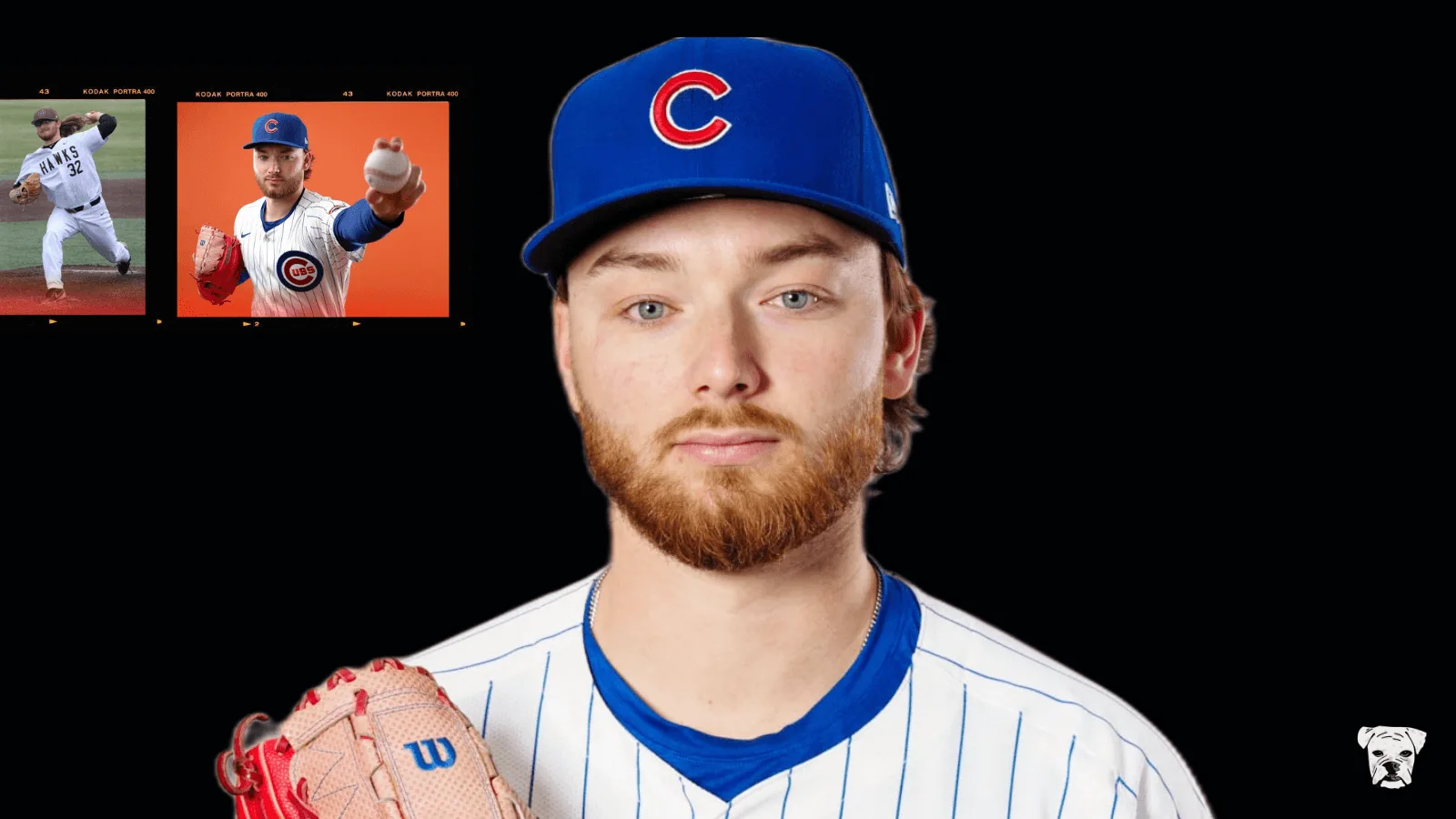
Your whole life can change in one year. Just ask Chicago Cubs rookie left-hander Riley Martin.
Back in 2020, he was four starts deep in his senior season of baseball at Division II Quincy University in Illinois – a school with just over 1,000 students situated five minutes east of the Mississippi River.
Riley had already finalized his post-graduation plans. After getting his bachelor’s degree in chemistry and biological sciences, he’d be attending pharmacy school at Southern Illinois University Edwardsville.
In fact, he’d gained early admittance and was already enrolled. His classes were picked, his schedule was finalized, and he was geared up to pursue his career as a pharmacist.
“I was like, I’m just trying to have fun [in] my last couple years of baseball.”
Then, on March 12th, 2020, a day after sweeping a doubleheader, Quincy’s baseball season was canceled due to the COVID-19 pandemic.
Just like that, Riley’s baseball career was all but over.
Up to that point, he wasn’t exactly an MLB prospect.
His career ERA hovered just under 4.00, his strikeout numbers were nothing special, and his velocity wasn’t blowing up the radar gun. Quincy University had only produced a handful of pro prospects in its 150-year history, and even fewer who reached the big leagues.
The 2020 MLB Draft was trimmed down to five rounds, and there was a very slim chance Riley was on any team’s draft board to begin with.
But he was determined to go out on his own terms. After the NCAA granted all 2020 student-athletes an extra year of eligibility, he knew what he wanted to do.
He told Greg Huss from Cubs on Deck, “I called Edwardsville and said, ‘Hey, I’m gonna defer my acceptance for a year. I wanna go back and finish my [college baseball] career. I don’t want it to go out like that.’”
There were a few program records he wanted to try to break at Quincy. But other than that, pharmacy school was still the plan. He even signed up for graduate classes to pursue his MBA in healthcare administration from Quincy.
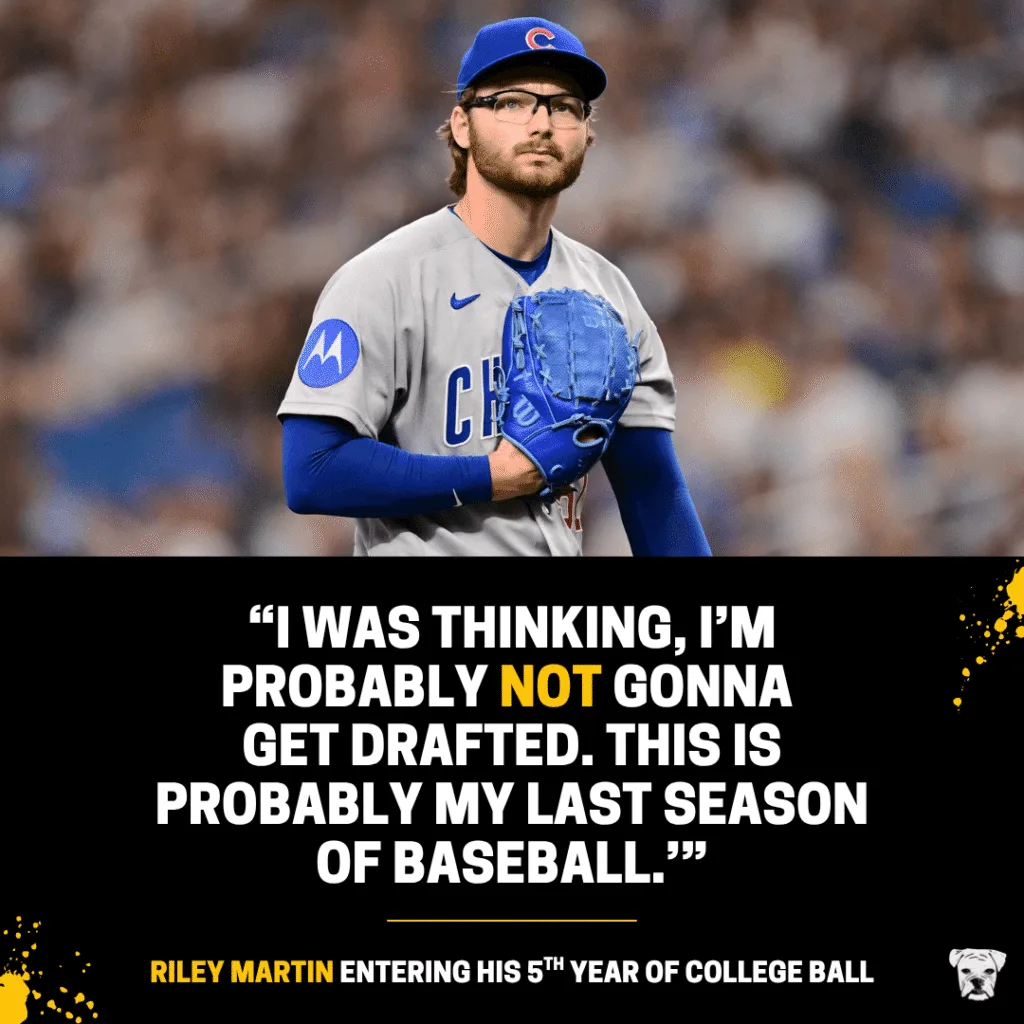
“At that point, I was thinking, I’m probably not gonna get drafted. This is probably my last season of baseball…I was like, ‘This is my last chance at it.’”
With shutdowns across the nation, Riley didn’t have access to Quincy’s facilities. But he found a way to take advantage of his newfound free time.
He set up a squat rack in his mom’s garage and went all-in on strength training.
“Me and my buddies would just go in there and lift for hours on end. Just get after it. And I got really, really strong…I called it a powerlifting phase, so I’d just go in there and lift as heavy as I could every single day.”
As often as twice a day, he opened up the garage door, cranked some tunes, and pumped some iron.
During that time, Riley never even picked up a baseball. He wasn’t throwing, working on his mechanics, or doing anything baseball-related.
His goal was simple: get stronger and more athletic for his final season of college baseball.
During the day, he worked a side job installing above-ground pools with his friends. When he got back in the afternoon, he hit the home gym to lift weights for hours on end.
By the time he stepped on the field for fall ball in his 5th year, he was a whole lot stronger, but his arm was in pain.
He was out of practice. His body just wasn’t used to throwing every day.
It took him time to ramp up. But once he did, everything clicked.
From his freshman through junior year of college, Riley’s velocity sat between 84 and 86 miles per hour.
By the spring of his 5th year, he was topping out at 94. He was a completely different pitcher.
In his first four years of college, he was the prototypical “crafty lefty” – a sinkerballer with a rubber arm – and struck out an average of 7.9 batters per 9 innings. Good, but not good enough to get attention from the pro level.
“I was getting outs, and it was good,” he said. “But I wasn’t overpowering anybody.”
But in 2021, Quincy brought in a data analyst, who advised Riley to swap out his sinkers at the bottom of the zone for four-seam fastballs at the top of the zone.
That one piece of advice changed everything, and his numbers jumped through the roof.
He averaged 17.4 strikeouts per 9 innings.
There are only three possible outs each inning, and Riley was striking out about two of them. In one game in mid-March, he struck out 18 batters in 8 innings. In early May, he struck out 19 across 7 innings.
By the end of the season, he led all of Division II in both total strikeouts and strikeouts per 9 innings.
His mindset shifted, too. Instead of just trying to get batters out, he wanted to “smother” them.
“I go into, like, a different mode when I’m out there on the mound. Off the field, I’m a really nice guy…on the field, it’s the complete opposite. My wife actually calls my alter ego ‘Jack’. She goes, ‘When you’re out there, you just black out, and you have no idea what’s going on.’”
“It was like, alright, I’m out there to strike everybody out…this guy’s trying to take my money, so I’m going to do everything I can to not let him do that.”
It only took three or four games for MLB teams to start sniffing around. And by the end of the season, he was pretty certain he was getting drafted. It was just a matter of which round.
That July, Riley’s dad hosted a draft party with some family and friends from his hometown in Salem, Illinois.
As the rounds passed and other names were called, the nerves became too much to deal with. So he tried his best to distract himself.
With everyone else locked in on the TV, watching and waiting, Riley stared down at his phone, scrolling through social media.
“Then all of a sudden, I hear my name get called. And it was such a surreal feeling. I got up and hugged my dad. It was just really awesome.”
He was drafted with the 184th overall pick in the sixth round. According to MLB senior writer Jim Callis, that slot was worth $263,700.
Instead, the 23-year-old signed for just $1,000 – the second-lowest amount for anyone in his draft class.
Why so low?
Well, as a fifth-year senior, he didn’t have the leverage of returning to school. Plus, the Cubs signed their earlier pick to a large deal over slot value. Believe it or not, there’s only so much money to go around.
But whether it was $1 or $1,000, Riley Martin was just thrilled to keep playing baseball.
After signing on the dotted line, it didn’t take long for reality to sink in.
Coming from a small Division II program, he didn’t know what to expect in professional baseball. But he did know that he’d have access to more resources than he could have ever dreamed of in college.
“I just wanted that opportunity to see how good I could get.”
From his first summer of pro ball in 2021, Riley advanced through the Cubs’ system in a natural progression. He moved from Low-A to High-A in 2022, then from Double-A to Triple-A in 2023 before settling there for a few seasons.
Each progression felt like a natural leap, right up until he hit the International League with Triple-A Iowa. That jump was the biggest.
“Everyone there either has big league time, is a big league veteran, or is on the brink of being a big leaguer. They all have an approach…they’ll go up there and just sit on whatever pitch is your best pitch, and they’ll just wait to get it. If they don’t get it, and you strike ‘em out on a fastball, fine. They’ll take that. But if they get the pitch they’re looking for, they’re gonna hit it.”
After struggling in his first full season in Iowa with a 4.48 ERA, Riley buckled down and posted a 2.69 ERA in 2025, striking out 80 Triple-A batters in 63.2 innings.
Then, after logging just 3 innings there to start the 2026 season, the Cubs’ brass had seen enough. Riley got the call-up to The Show on April 5th.
In his first pregame interview in the big league clubhouse, one reporter asked him how his background at the Division II level shaped him.
“The D2 grind is no joke,” he said. “My head coach played in the big leagues, so he kinda took me under his wing and taught me what it was like to be a pro…I kinda came from the bottom and just grinded through it. I think going that route taught me to just keep going.”
Today, Riley Martin’s fastball averages 94.5 miles per hour.
Instead of filling prescriptions at your local CVS, he’s filling up the strike zone in front of big league crowds.
The 28-year-old rookie has already struck out some of the game’s biggest names: Kyle Schwarber, Trea Turner, and Oneil Cruz. Two first-round picks and a guy who signed for $949,000 more than he did.
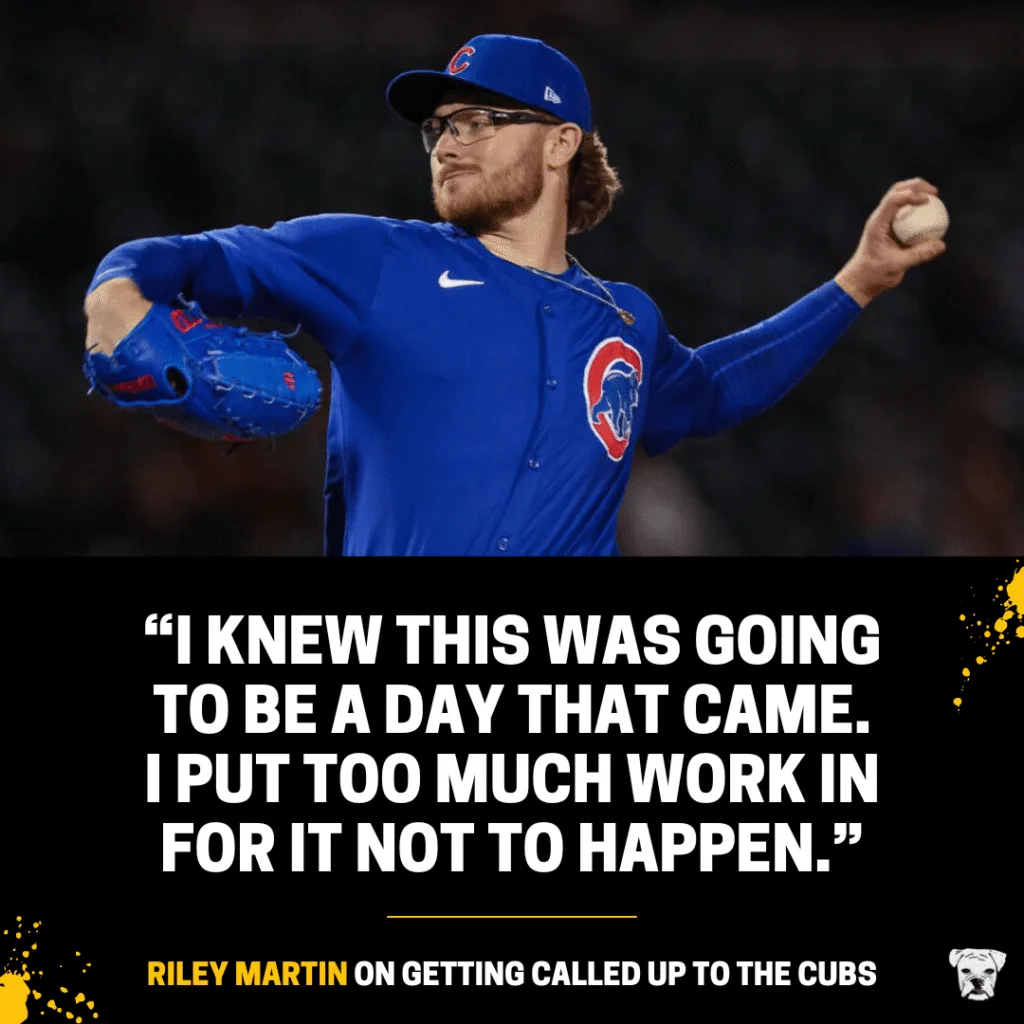
“I know it’s easy to say now that it happened, but I knew this was going to be a day that came,” Riley told Muddy River Sports.
“I put too much work in for it not to happen. I really pride myself on getting better each and every year and attacking the weaknesses in my game. So I knew this was going to happen. It’s just a matter of when, and now that I’ve got that checked off my box, I’m excited to just keep going.”
If you want more underdog stories like this, join my free weekly newsletter 👇