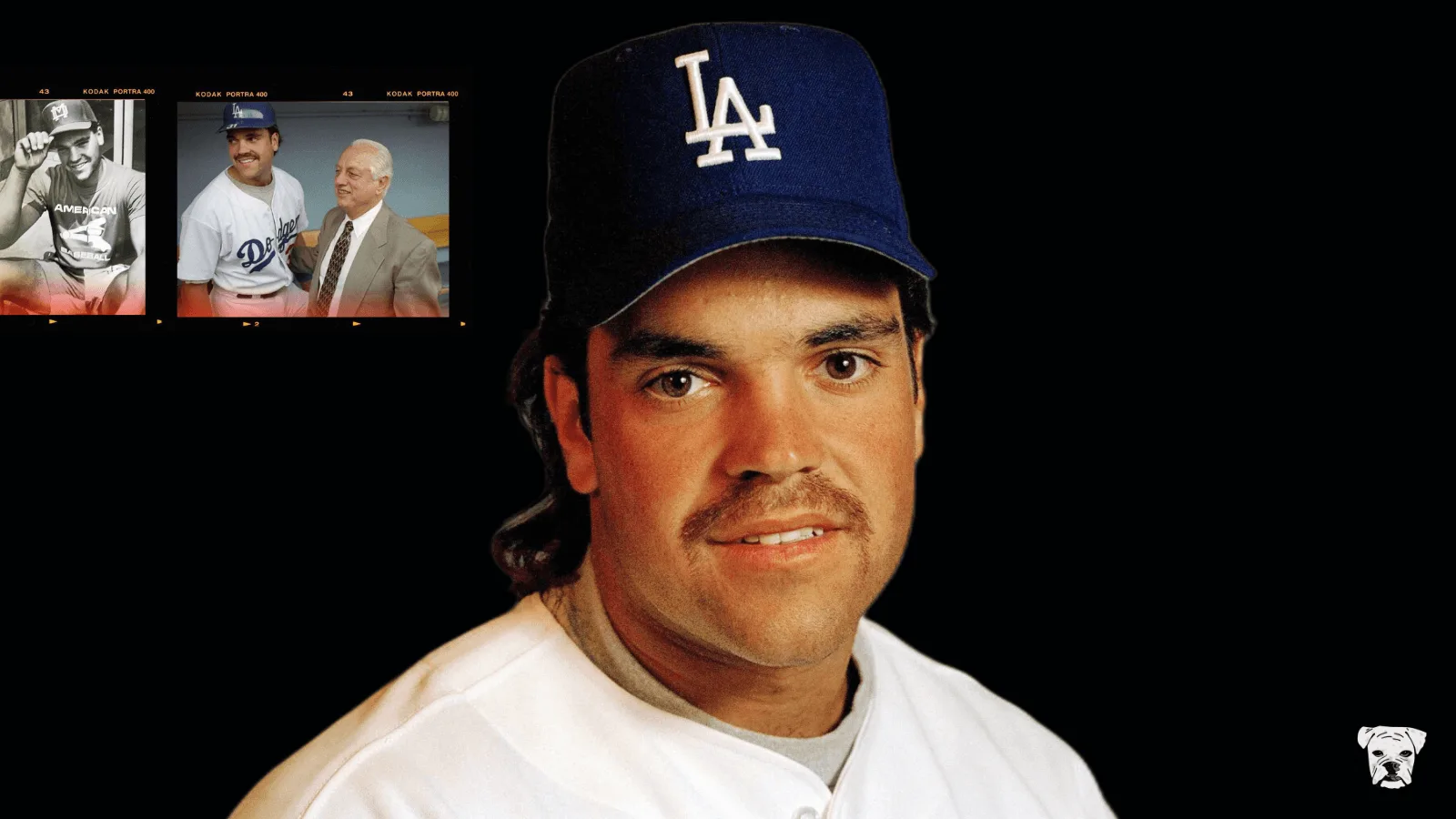
There’s a video of 16-year-old Mike Piazza in the deepest corner of the internet. He’s taking cuts in a batting cage in his backyard.
Suddenly, Ted Williams enters the frame. Yes, that Ted Williams. Teddy Ballgame – 19-time All-Star, 6-time batting champion, and first-ballot Hall of Famer.
“This kid looks good, he really looks good,” Williams says in the video.
“I’m gonna tell you the truth, I don’t think I hit the ball as good as he does when I was 16.”
Before leaving the Piazza home, Williams signed a copy of his book – The Science of Hitting – with a note: “To Mike, follow this book. As good as you look now, I’ll be asking you for tickets.”
Imagine being 16 years old, and hearing that kind of praise from one of the greatest hitters of all time. What would it do for your confidence?
“It was crazy,” Piazza said later.
“The one thing I’ll never forget that Ted Williams said was, ‘You look great, but that’s only half the battle. The rest is pitch selection, knowing your strike zone, hitting the ball where it’s pitched, reacting to situations and off-speed.’ And it just kind of seared in my memory.”
It wasn’t the youngster’s first time being around an MLB player.
As a kid, he had the chance to serve as the Dodgers’ bat boy when they played at Veterans Stadium in Philadelphia. They even let him take a few swings on the field before the game, and he reportedly launched one into the seats.
Those experiences all came through a family connection that would become well documented in the years to come.
Mike’s father, Vince, grew up with Tommy Lasorda in Norristown, PA.
Vince went on to become a successful entrepreneur, and Tommy became the manager of the Los Angeles Dodgers. The two remained close friends, which led to opportunities for the younger Piazza – like Ted Williams visiting his backyard batting cage.
Regardless of the baseball legend’s positive feedback, the teenage Piazza still needed time to develop. And there was plenty of work to do.
He went to Phoenixville High – a school with just 200 students in his class and a home baseball field that didn’t even have a fence in left field.
While he hit .442 and shattered the school’s home run record as a senior – mostly through opposite field shots, where there actually was a fence – he received little attention from major college programs or MLB scouts.
According to MLB Network, only one scouting report was ever filed on him in high school. The grades ranged from “below average” to “poor” across the board.
So far, no one saw what Ted Williams did.
Mike landed at the University of Miami, where he hit just .111 as the Hurricanes’ backup first baseman. Realizing he was in over his head, he transferred to Miami-Dade Community College for a better opportunity.
Both chances were sourced through Lasorda.
Still, despite hitting .364 at the JUCO level, he wasn’t even a blip on a pro scout’s radar.
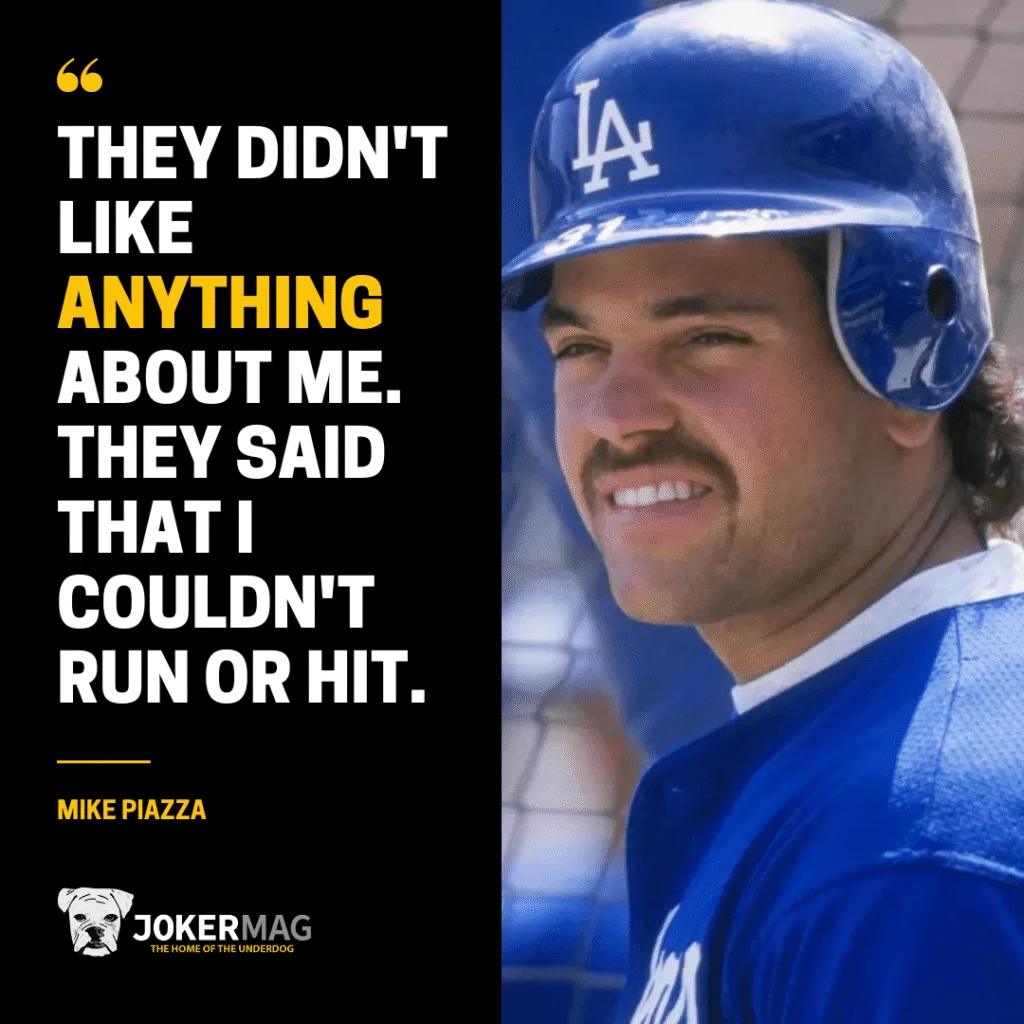
“They said that I couldn’t run or hit,” Piazza told Sports Illustrated in 1993.
That’s when Tommy Lasorda stepped in and tried to pull some strings.
“I asked five different friends of mine to go out and see him play, hoping they would sign him,” Lasorda told MLB Network. “And all five came back and told me he can’t do it.”
Playing pro baseball was Mike’s one and only dream, and the lack of interest started to get to him.
“That’s when we started kicking the idea of possibly changing and converting to a catcher,” Piazza said.
Ultimately, the Dodgers took the 19-year-old in the 62nd round (1,390th overall) of the 1988 MLB Draft as a favor to Lasorda.
“I said ‘Draft this guy’, and they didn’t wanna draft him,” the manager remembered. “I said, ‘I want him drafted. I don’t care where you draft him, but draft him.'”
Because it was viewed as a favor, no one in the organization took the pick seriously. In fact, the Dodgers’ brass didn’t consider signing him until Mike requested a formal tryout.
In front of Lasorda and the Dodgers’ scouting director, Ben Wade, Piazza put on the performance of a lifetime.
“I just hammered balls into the blue seats.”
But Mike was drafted as a first baseman. And the Dodgers didn’t need another one. After all, that kind of size and power wasn’t uncommon at the position.
So Lasorda framed it differently.
“If he was a catcher who could hit balls into the seats like that, would you sign him?” he asked.
“Yes,” replied Wade.
“Then he’s a catcher,” Lasorda said.
Wade protested, asking to see Piazza make a few throws to assess his arm strength.
“I threw as hard as I could,” Mike remembered. “I think my arm is still hurting from that day.”
After the tryout, Ben Wade offered Piazza a $15,000 signing bonus.
“He could have said $15, and it wouldn’t have mattered.”
Thanks, in part, to his father’s connection with Tommy Lasorda, Mike Piazza got his foot in the door of Major League Baseball.
But he still had to learn a new position. He still had to step in the box against some of the best pitchers in the world. And he still had to put in the work to make it happen, day after day, season after season.
Through his first two seasons at Single-A, Piazza hit just .257 and had nearly as many strikeouts (119) as he had hits (121).
At one point during the 1990 season, he was so discouraged that he stepped away from the game and went home to Pennsylvania.
“It was so bad, I said, ‘I am out of here,’ and I just walked away,” Piazza said.
He was tired of struggling – and being looked down upon by players and coaches in the organization.
“The manager would look at me and see how unpolished I was and say, ‘I don’t get it. I don’t think this kid can play.'”
That’s when Dodgers minor league hitting instructor – and 7-time MLB All-Star – Reggie Smith went to visit him.
“I told him there were people fighting for him,” Smith told MLB Network.
Piazza returned to baseball and played better than ever. He quickly rose through the ranks of the minors and became the Dodgers’ number one prospect.
He told himself, “I am going to go out there and play with a chip because the other way isn’t working.”
Baseball fans know the rest.
Piazza’s underdog mentality worked like a charm and carried him all the way through his big-league career.
1,912 MLB games and 427 home runs later, Mike Piazza is the lowest draft pick in history to be inducted into the Baseball Hall of Fame.
“My father’s faith in me, often greater than my own, is the single most important factor of me being inducted into this Hall of Fame,” he said in his speech.
“I know he watched every game, cried when I cried, was angry when I was angry, and celebrated more than I could ever celebrate. He is a man deeply devoted to his family…We made it, Dad. The race is over. Now, it’s time to smell the roses.”
Want more sports stories you’ve never heard before? Join thousands of subscribers on my free Underdog Newsletter 👇
Here are a few more related stories you might like: