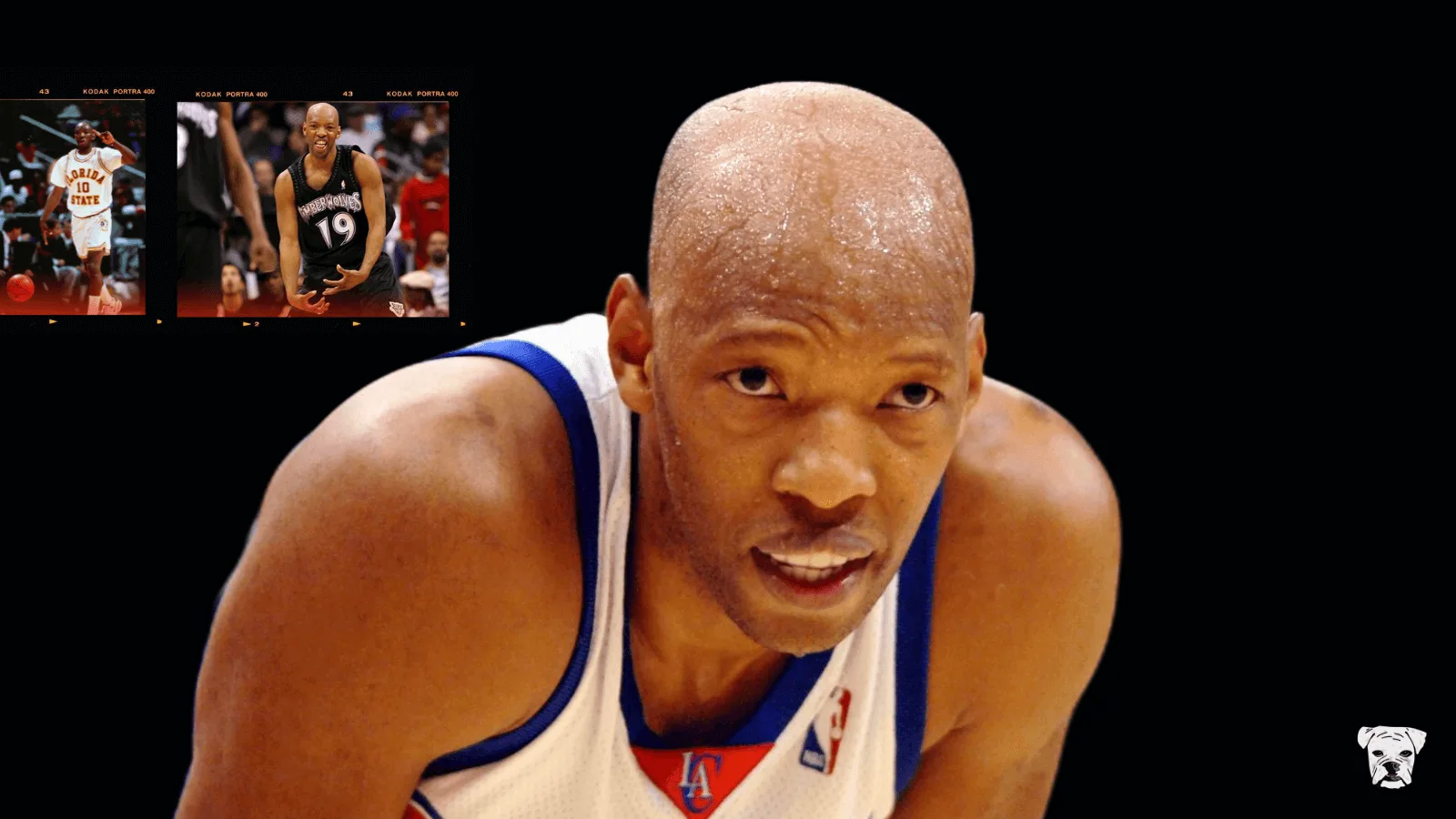
Like many of the athletes featured on Joker Mag, Sam Cassell’s story isn’t about being the most talented or having an easy path to success.
It’s about his resilience, about a kid coming back to prove doubters wrong. It’s about a young man who didn’t take a direct route through college. It’s about a player who bookended his solid, but unspectacular career with NBA titles (with a third one thrown in during his second year). It’s about the “big balls dance”.
Born in November 1969, Samuel James Cassell grew up in the rough East Baltimore neighborhood. With poverty, high crime rates, and drugs all just steps away, he turned to basketball as a way to stay out of trouble.
Playing at the famed Dunbar High School – the same school that produced Muggsy Bogues, Reggie Lewis, Reggie Williams, and Terry Rozier – Cassell was named Baltimore’s Player of the Year during his senior season, leading the Poets with an average of 22 points and 9 assists per game.
While the stats were impressive, his grades weren’t.
In an effort to boost his grades, he enrolled at Maine Central Institute in Pittsfield, Maine, a far cry from the tough streets of Baltimore. It was a major culture shock. From the busy streets of Baltimore to the small town of Pittsfield, it only took a month for Cassell to return to his roots, driven by homesickness.
After second-guessing his decision to leave, he returned to MCI, where he was eventually recruited by DePaul University, but was academically ineligible.
Rather than playing for the prestigious Big East program, he went to Pasadena, Texas, to play junior college ball with the San Jacinto Ravens.
Earning Junior College All-American status while with the Ravens, Cassell also earned praise from Dick Vitale’s Basketball Magazine as the best JUCO player in the nation.
His play with the Ravens grabbed the attention of Florida State Seminoles head coach Pat Kennedy, joining the team for his junior year.
Teaming with future NBA guards Bob Sura and Charlie Ward, as well as forward Doug Edwards, the Seminoles advanced to the Sweet Sixteen of the NCAA Tournament.
A year later, Cassell finished his collegiate career averaging 18.3 points, 4.9 assists, and 4.3 rebounds while leading the ACC in steals. Teaming with Sura to form the highest scoring and rebounding backcourt in the nation, the dynamic duo led the team to a 25-10 record and a spot in the Elite Eight.
Even in college, his confidence bordered on legendary.
After a game at North Carolina, he famously took shots at the Tar Heel faithful, suggesting their crowd was more of a relaxed, wine-and-cheese atmosphere than the intense, Duke-style environment.
The comment has lived on ever since, used by UNC supporters to fire up their fans. It was typical Cassell behavior, never afraid to speak his mind or stir the pot.
While he wasn’t the fastest or strongest, his confidence and clutch play made him a first-round draft pick by the Houston Rockets in 1993.
Selected 24th overall, Cassell was the fourth point guard taken in the draft behind Penny Hardaway, Bobby Hurley, and Lindsay Hunter. Playing on a veteran-filled Rockets team featuring Hakeem Olajuwon, Otis Thorpe, and Kenny Smith, Cassell averaged 17 minutes off the bench during the regular season of his rookie year.
His personality was impossible to ignore.
Teammates recalled how Cassell would burst into Houston’s early-morning practices, yelling at Hakeem and Smith, his voice echoing through the gym. He had a habit of comically exaggerating everything, a trait that went back to childhood.
His mother remembered that when he got excited as a kid, he’d talk so fast that he’d drool, earning him the nickname “Guppy.”
That same energy and enthusiasm translated to the court, where his steady hand and clutch play earned him additional minutes during the Rockets’ playoff run, helping Houston win its first NBA championship.
“I remember after the game, Vernon (Maxwell) and Kenny (Smith) were crying,” Cassell said. “I was looking at them and thinking, ‘What’s wrong with you boys?’ I didn’t respect the journey because I had won a championship my first season.”
Although his minutes increased in his second season, Cassell still came off the bench behind Smith. But what mattered most was that he was on the floor.
The Rockets, after outlasting the Utah Jazz, Phoenix Suns, and San Antonio Spurs, found themselves playing for their second straight NBA title, this time against the young and talented Orlando Magic. In a series that saw Olajuwon put Shaquille O’Neal through a master class for big men, Cassell found himself outplaying Smith, which included a 31-point effort in Game 2.
Two rings in two years for a player who spent two seasons in junior college and then was a late first-round draft pick. Not a bad way to start an NBA career.
Although a three-peat was not in the cards, Cassell had proved his worth to the Rockets as a steady sixth-man option who could not only facilitate the offense but also get buckets.
Then came the roller coaster 1996-97 season.
Traded to the Suns in August, Cassell once again found himself moving back to Texas on Boxing Day, this time to play for the Dallas Mavericks. His stay in the Big D lasted just 16 games, as by March, he was on the move to New Jersey.
Three teams in one season.
Whether you see that as one team not wanting you or as a team that does, the instability can easily shatter one’s confidence, especially a 27-year-old in just his fourth season.
The silver lining in being traded to the Mavericks and Nets was that Cassell found himself as a starter for both teams. Improving both his scoring and assist numbers, he became a leader in New Jersey.
Unfortunately, just as soon as he settled himself, he was on the move again, this time in a multi-player three-team deal between the Nets, Minnesota Timberwolves, and his new home with the Milwaukee Bucks.
Teaming with Glenn Robinson and Ray Allen, Cassell evolved into more than just a role player. In five seasons with the Bucks (the longest stay of his career), he helped the team to four playoff appearances, including a memorable seven-game Eastern Conference Finals series against the Philadelphia 76ers.
Possessing a game that was built on a methodical pace rather than speed, a mid-range game rather than long distance shooting, and a crafty finish at the hoop rather than athleticism and power, Cassell had an old man’s game in a young man’s body.
The summer of 2003 found Cassell packing his bags once again, this time to join Kevin Garnett and Latrell Sprewell in Minnesota. Eleven years after starting his NBA journey, Cassell posted his career best stat line, averaging 19.8 points, 7.3 assists, 3.3 rebounds, with shooting percentage splits of 48/39/87.
Not only would Cassell earn his first trip to the All-Star Game, but he was named to the All-NBA Second Team and ranked in the top ten for MVP voting. Two more firsts came in the 2003-04 season, as he helped the Timberwolves to their first trip to the Western Conference Finals, and he introduced the world to one of the league’s more memorable big shot celebrations.
Playing alongside Garnett, whose energy had legendary infectiousness, created a new level of intensity and competitive fire within Cassell.
“He’s the best teammate I’ve had in that aspect; I never seen a guy get goosebumps. He was just shaking. He was just so intense,” Cassell said of his teammate.
After hitting crucial shots, he performed what became known as the “big balls dance”, a gesture he admitted he borrowed from the movie Major League II.
Love it or hate it, you couldn’t ignore it. And you couldn’t ignore what it represented: supreme confidence in the biggest moments. The NBA certainly didn’t ignore it, fining players anywhere from $15,000 to $25,000 for performing the celebration.
Unfortunately, that dance may have cost the Timberwolves a championship.
Years later, coach Flip Saunders revealed that Cassell actually injured his hip doing the dance after hitting a shot in Game 7 against Sacramento in the 2004 playoffs. The celebration created an avulsion fracture that significantly hampered him in the Western Conference Finals against the Lakers.
Minnesota lost that series, and one has to wonder what might have been if Cassell had stayed healthy.
After just two seasons with the Wolves, a new uniform awaited Cassell, the red, white, and blue of the LA Clippers. Midway through his third season in LA at the age of 38, the Clippers waived Cassell, allowing the point guard his first opportunity to actually have some say in which team he wanted to join.
Signing as a free agent with the Celtics late in the 2007-08 season, he rejoined Garnett and Allen, along with Paul Pierce, to help bring an 18th championship banner to Boston and a third ring for Cassell, bookending his career with titles.
While his averages of 15.7 points, 6 assists, and 3.2 rebounds per game over 15 NBA seasons are solid, they don’t scream Hall-of-Fame, even with three NBA rings.
However, Cassell’s story is more about a player who wasn’t afraid of the big moments, one who wasn’t afraid to swallow his pride and take a longer route or a back seat, one who proved people wrong and succeeded when others counted him out and bet against him.
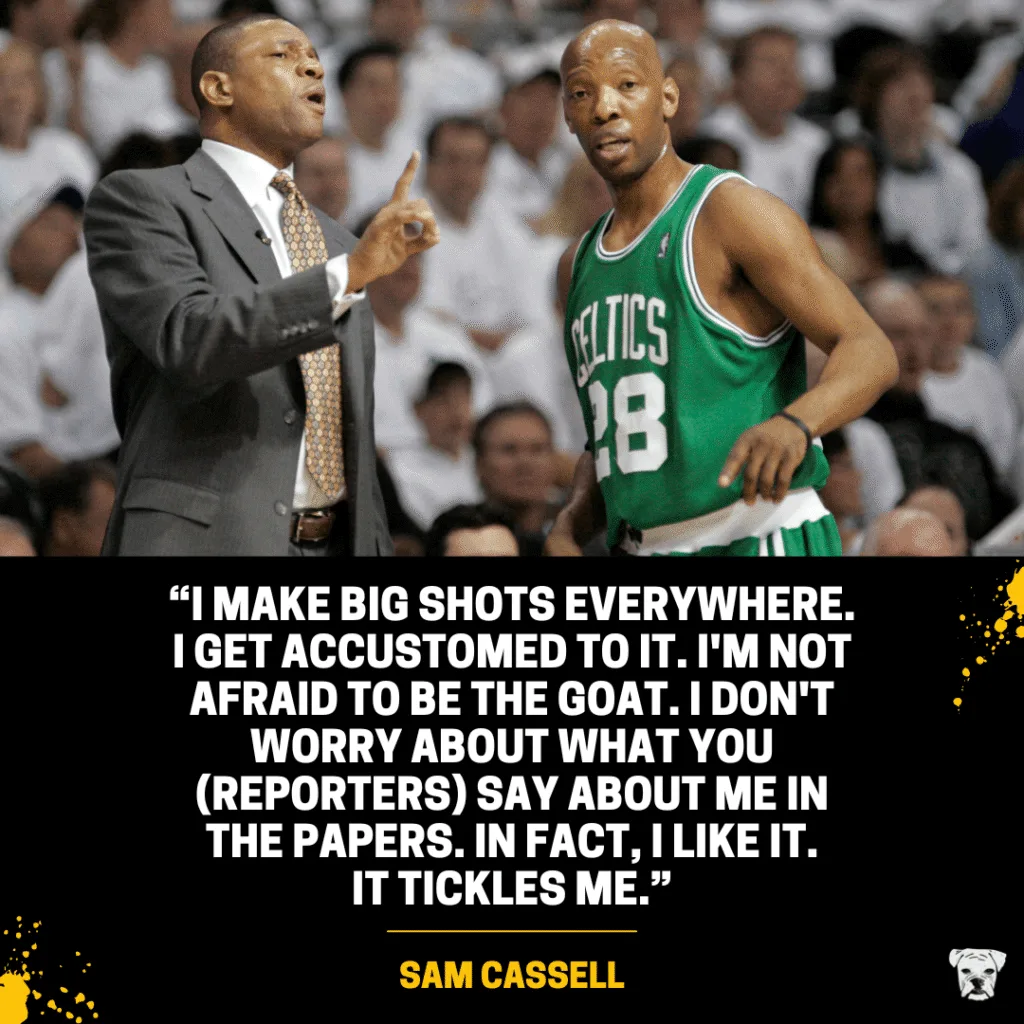
“I make big shots everywhere. I get accustomed to it. I’m not afraid to be the goat. I don’t worry about what you (reporters) say about me in the papers. In fact, I like it. It tickles me.”