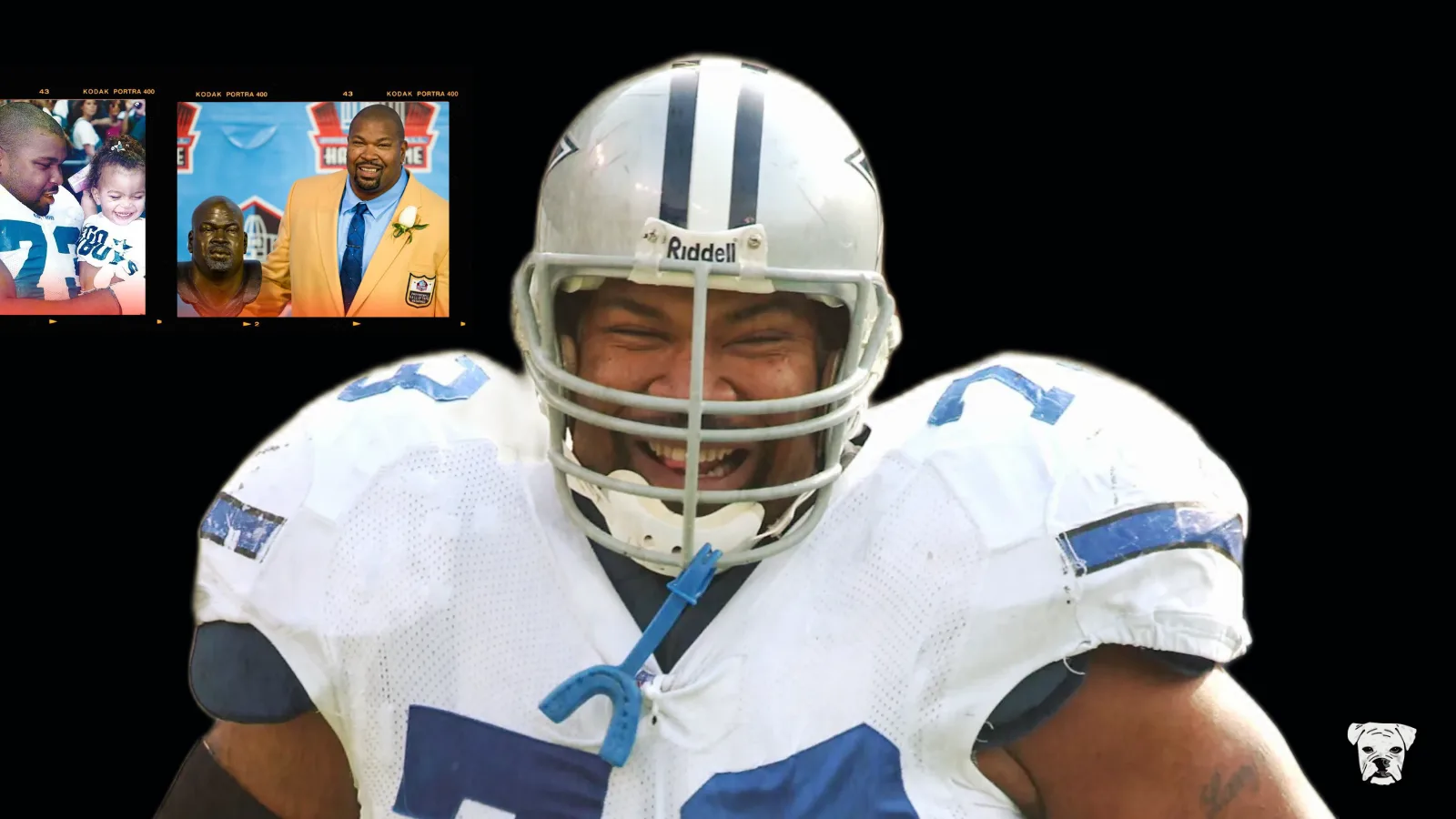
“Growing up in Compton, California, it’s rough out there.”
At 9 years old, Larry Allen put his life on the line.
While protecting his little brother from a bully, he got stabbed 12 times in the head and shoulder.
Three months after surviving the horrific attack, Larry did what few others would even consider.
He went to confront the bully.
“My mother said, ‘I’m not raising any punks,’ so she made me fight this guy,” Allen said in his Hall of Fame speech.
“She said, ‘You will fight him until you win.’ First day, I lost. Second day, I lost. The third day, I finally won. That was one of the most valuable lessons I learned in my life: never to back down from anybody.”
“I carried that lesson through my whole career.”
A career that almost never happened.
For most of his childhood, football wasn’t much more than a game that Larry played with his cousins on Thanksgiving.
He couldn’t afford to play Pop Warner, so his first taste of organized football didn’t come until he was a teenager.
But since his parents split up, Larry moved around often. He ended up attending four different high schools in four years.
Each year brought new teachers, new classes, new teaching styles, and new groups of friends.
You can probably guess what that did to his grades.
It’s tough to focus on academics when your main goal is survival.
Larry’s mother, Vera, once told the LA Times, “We would hear the gunfire outside our house, we would automatically roll out of the bed, lay on the floor until the shooting stopped, then get back in bed and go to sleep. After a while, we got pretty good at that.”
To escape the violence, Vera moved her boys five hours north to Stockton, California.
With next to no playing experience, Larry had to work up the courage to join the freshman football team there.
But shortly after he signed up, they were on the move to a new town. Uncomfortable in his new environment, Larry sat out his sophomore season.
Then, they moved back to Compton. And that’s when a conversation with his grandmother gave him the courage to go for it.
“She sat me down and said, ‘Larry, you need to find out what you’re good at and go do it.’…About two months later, it was my first year of football. I was a junior at Centennial High School in Compton.”
He turned some heads on the field, but ran into more trouble off it.
This was South Central LA in the late 80s. Gang activity was rampant.

He had to be careful of what he wore, what he said, and where he walked. Drug deals happened right outside his front door almost every day.
“I didn’t want to be a gang-banger or drug dealer,” he said. “It wasn’t for me. I wanted to do something for myself.”
So Larry asked his mom if he could return to Northern California.
She agreed, and he ended up at Napa’s Vintage High School for his senior year.
He met a friend there named Steve Hagland.
“He’s like my brother,” Larry said later. “[Steve] said, ‘Come on, come live with us.’ And his family, they treated me like I was one of their own.”
Allen was big, strong, and dominant on the offensive line. But his performance in the classroom made him ineligible for any NCAA program.
Poor grades kept him from getting his diploma. And he never even bothered to take the SAT.
Luckily, his high school’s dean of students was able to connect Larry with the head coach at Butte College – a community college in Oroville, California.
The team went 20-2 and won their conference in both of Allen’s seasons there. He earned all-conference honors twice and was named a JUCO All-American as a sophomore.
But, once again, the classroom was his downfall.
While he earned his GED during his time at Butte, he never finished his associate’s degree. With no options left, his playing career looked to be over after just two seasons of JUCO ball.
So he went back home to live with his mom in Compton and find work. There wasn’t much.
“I couldn’t even get a job at McDonald’s,” he said.
Larry was 19 years old with no degree, no job, no money, and no plan for the future.
His daily routine was mostly the same: play some basketball, watch some TV, and lift some cheap plastic weights he borrowed from his cousin.
“Those weights were tiny,” he said.
“I would lift them 100 times. Every day, at least 100 times. I didn’t know what I was waiting for. I was just, you know, waiting.”
That’s when Frank Scalercio came into the picture. As the offensive line coach at Sonoma State University, he’d scouted Larry Allen a year prior.
“There was this kid in the game throwing people around all over the place. He was picking them up and throwing them to the ground,” Scalercio said.
“I walked away from the game, and everybody told me, ‘Forget about it. You’re not going to get this kid. A big D1 school will get him.'”
The coach kept nosing around and finally found out that the big O-lineman never landed at a D1 program. To his surprise, he wasn’t playing anywhere.
Seizing the opportunity, Scalercio started calling around. But there were no cell phones back then, and he couldn’t locate the Allen family.
So he asked one of his players, who was traveling to LA for Christmas break, to find Larry. Check the basketball courts in Compton, he told him, and pass the kid a message.
“Call my coach,” the player said when he found him. “He wants you to come up to Northern California and play college football.”
Larry was just as surprised as the coach was. He thought he’d played his last down a year ago.
“When Frank called me, I didn’t have the grades to transfer up from [Butte College]. He said, ‘I can get you into school.’”
“I thought he was joking, honestly. I didn’t know there was a Sonoma State.”
After several conversations, Larry was convinced. So he threw his clothes in a couple of garbage bags and borrowed a teammate’s truck to make the 6-hour drive up to his new campus.
It took him four months of intense studying and summer classes to get the 24 credits he needed to qualify. He finished just in time for training camp.
Sonoma State was a Division II school, so they didn’t give athletic scholarships. It had just three full-time coaches, a stadium with no lights, and a single set of bleachers.
“I couldn’t believe how quiet it was here,” Allen said. “At first I thought, ‘Where am I?’ But then I realized, this was my last chance. I had to do it here, or nowhere.”
Scalercio knew that he’d found a diamond in the rough.
“Our first practice, he was killing people,” the coach said.
“He never bragged about it, but he knew he was good. He just didn’t know how good he was.”
Larry had two things you can’t teach: size and strength.
When he got to Sonoma State, he told his coaches that he didn’t enjoy lifting weights. So they made him a deal: if you can break the school’s bench press record of 365 pounds, you don’t have to lift.
So without warming up, Allen loaded up 370 pounds on the bar, performed a single rep, racked it, and left the weight room.
In two full seasons of Division II football, Larry Allen was a two-time All-American and only allowed one sack.
Only one time did a defensive player push past him and sack the quarterback.
“I wanted to make you quit,” he said. “I wanted you to tap out.”
He was named Offensive Player of the Year as a senior – an award typically reserved for a star quarterback or running back.
Even though he was playing at a small school in a rural area, word spread to NFL scouts. He earned invites to both the East–West Shrine Game and the Senior Bowl.
Then, in the second round of the 1994 NFL Draft, he was selected by the Dallas Cowboys.
“I remember getting a call from Jerry [Jones] saying, ‘Son, would you like to be a Cowboy?’ I said, ‘Yes, sir.’ Ran out of my apartment and jumped into the swimming pool with all my clothes on.”

Larry’s mom only saw him play once in college, taking the bus three hours back and forth to do it. He promised her back then that, when he got drafted, he’d buy her a car.
After signing his rookie deal with Dallas, he fulfilled that promise. And for good measure, he bought her a house, too.
“Everything she gave and did for my brother and me, that was the one gift I was able to give to her,” Allen said.
“She did everything for my brother and me. My life could’ve ended up much differently.”
Nine offensive linemen were drafted before Larry. He turned out to be not only the best guy at his position, but perhaps the best player in his entire draft class.
“It’s like going against a bear,” said Hall of Fame defensive tackle John Randle. “Man, he would grab you, pick you up, and start laughing. And there’s nothing you could do.”
“I’ve seen him take linebackers, [and] just drive ‘em 20 yards. Not 5, not 10…20 yards.”
In his second NFL season, Allen earned his first of 11 Pro Bowl nods and helped the Cowboys win Super Bowl XXX.
Helping protect quarterback Troy Aikman and pave the way for running back Emmitt Smith, Allen’s career accolades include:
- Dallas Cowboys Ring of Honor
- NFL 1990s All-Decade Team
- NFL 2000s All-Decade Team
- NFL 100th Anniversary All-Time Team
He was also considered one of the strongest players in NFL history.
The guy who refused to lift weights in college? He bench pressed 700 pounds and squatted 900 as a pro.
In 2013, he was immortalized in the Pro Football Hall of Fame.
In his enshrinement speech, he said, “My goal was simple: to earn a seven-letter word called respect. The respect of my teammates, opponents, and the NFL. Today, my mission is complete.”
Unfortunately, Larry passed away in 2024. He was 52 years old.
While his time on this earth came to an end, his legacy will live on.
His story proves that there is truly no challenge too big to overcome. Even when your back is against the ropes, and all hope seems lost, you can still punch your way back into the fight – and win.