In sprint kayaking, a 200-meter race is over in under 40 seconds. To a spectator, it happens in the blink of an eye: an explosive start, a flurry of powerful strokes, and the paddlers are already crossing the finish line.
For young kayaker Arseni Mashko, those fleeting seconds demand absolute focus: a strong start, aggressive acceleration, building to top speed, and then locking into precise technical cues — stay loose, maintain the rhythm, feel the boat’s balance, and drive the blade into the water clean and sharp.
“If you just start mindlessly thrashing your arms, the boat rocks, lactic acid burns out your muscles, the hull settles, and you lose speed immediately. For me, the 200-meter sprint is all about controlled aggression,” Arseni explains.
This year, that controlled aggression earned him two gold medals at the Sprint National Championships, winning both the Senior Men’s K1 200m and K2 200m events.
Behind those results, however, lies a deeper story of grit, discipline, and bold decisions.
From a Local Club to Elite Sport
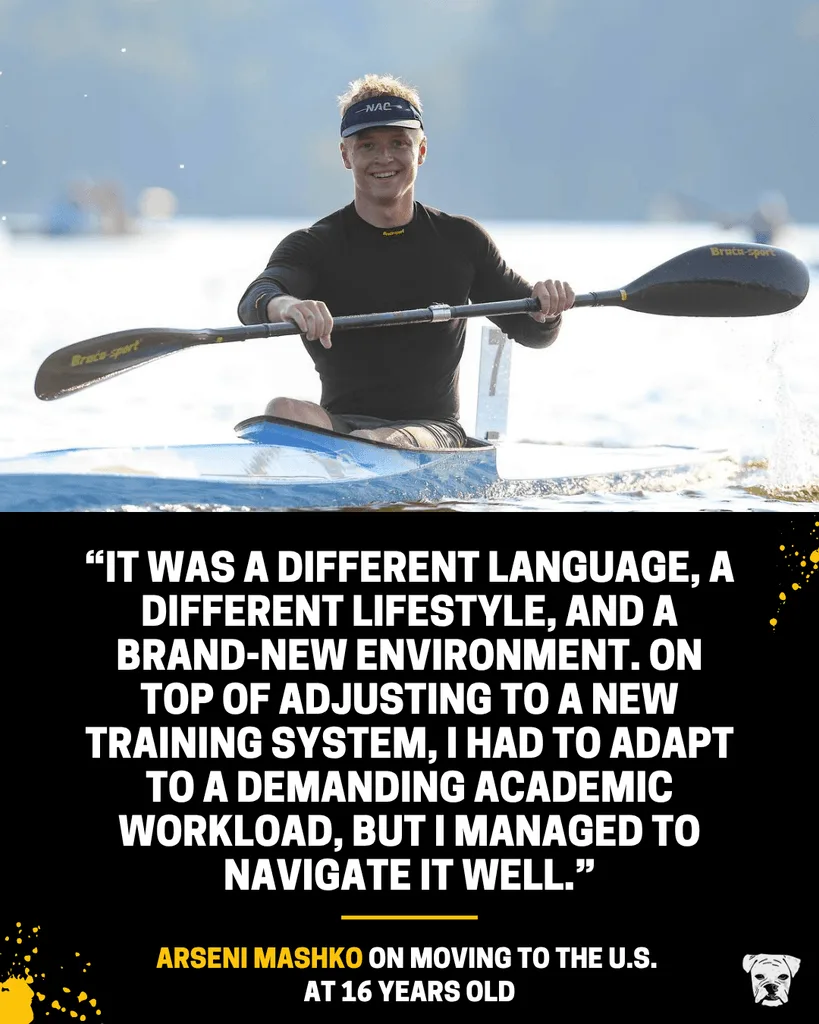
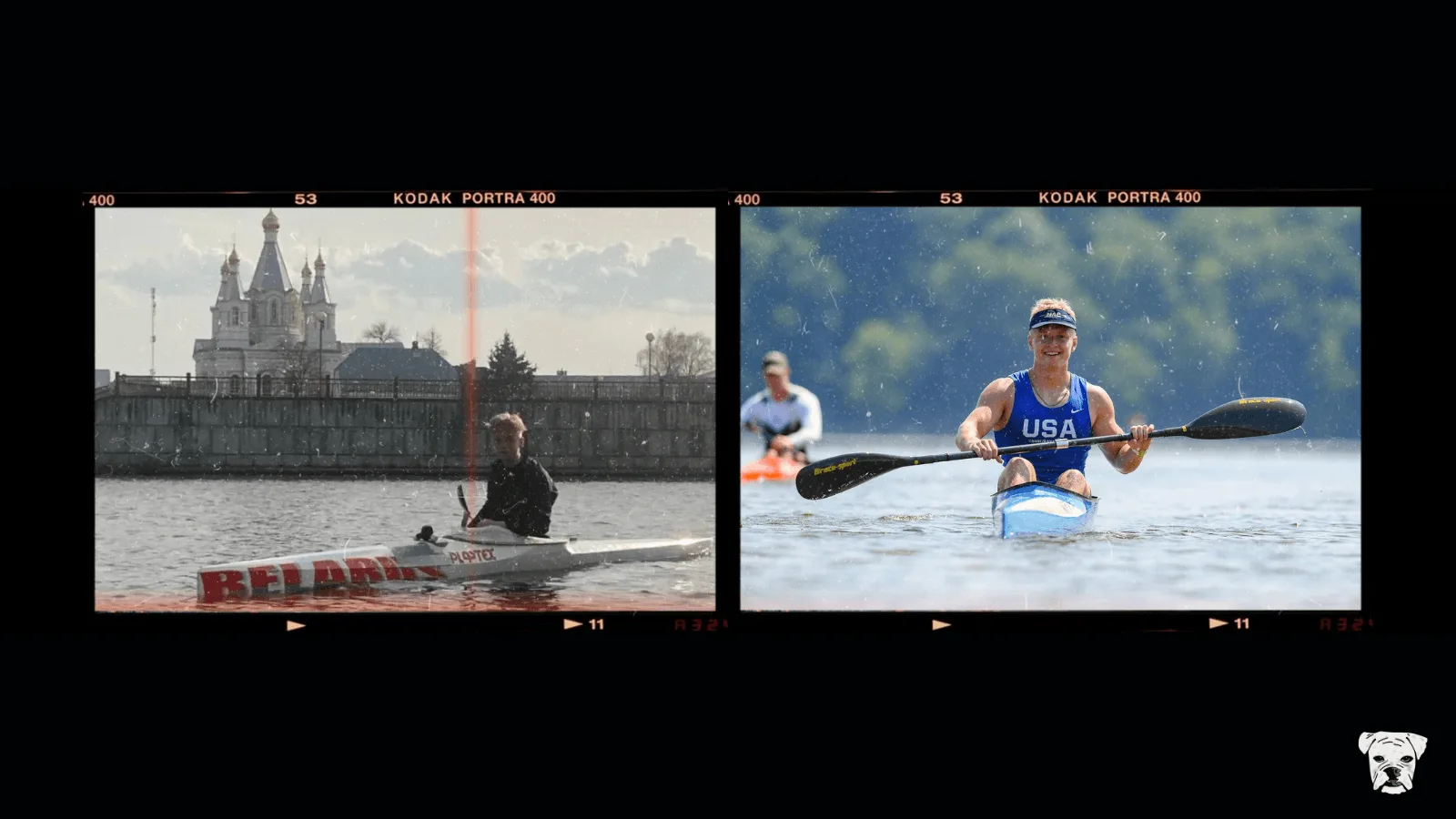
Arseni began kayaking back in Belarus at the age of ten, joining a local youth sports program. He admits that early on, it wasn’t the speed that hooked him, but the water itself and the vibrant world his coach built around the sport.
“In our very first year, we were cross-country skiing in the winter, playing soccer in the summer, swimming, weight training, and going to camps and training trips. To a kid, it didn’t feel like grueling professional labor; it felt like one long sports camp where there was always something new happening. My coach was strict: he’d had a serious career of his own, winning European medals, but he knew how to connect with us and truly believed in me. I think he’s the one who passed down his love for this sport to me,” Arseni recalls.
Big wins didn’t come right away.
Supported by his parents and coach, Arseni focused on steady progress, watching his technique, fitness, and race times gradually improve. In 2019, he earned his first medal at a national youth competition, and his athletic growth accelerated from there. Kayaking quickly became a way of life.
By age 14, Mashko was admitted to the Olympic Reserve School in Minsk and was later selected for the Belarusian Youth National Team. Competing regularly at major national events, he began to embrace the idea that sports could become his lifelong profession.
Looking to grow into an elite athlete, Arseni sought an environment that combined top-tier coaching with optimal weather conditions and world-class infrastructure. At 16, he was awarded an athletic scholarship to Point Loma Nazarene University and relocated to the United States, joining and competing for the San Diego Canoe & Kayak Team.
Notably, Arseni became the first international athlete in his club’s history.
For a teenager starting young adulthood in a completely foreign country, the transition was a massive test.
“It was a different language, a different lifestyle, and a brand-new environment. On top of adjusting to a new training system, I had to adapt to a demanding academic workload, but I managed to navigate it well. I knew what a rare opportunity this was: I’d be training alongside U.S. National Team members, Olympians, and World Championship medalists. Seeing athletes of that caliber every single day gave me extra motivation — it showed me exactly what standard I needed to strive for,” Arseni shares.
Just a year after moving, at age 17, he won two events at the U.S. Sprint & Paracanoe Team Trials, the country’s premier selection event, and took silver in a third. What seemed like the start of an unstoppable rise after 2023, however, soon gave way to a challenging period of adversity.
“It has always been crucial for me to have a clear target ahead. That’s why transitioning from the junior ranks to the U23 category was psychologically tough. Because of eligibility rules and my immigration status, I knew in advance that I couldn’t fully compete for a spot on the U.S. National Team. When an athlete doesn’t have a signature race to suffer for in training every day, finding the drive to push through becomes so much harder. In 2025, I returned to senior-level racing and gained valuable experience, though I knew I was capable of much more,” Arseni reflects.
He approached the following season with a renewed mindset. At the Selection Trials, he laid down a 37-second clocking in the 200m — the third-fastest time among all published preliminary heats in the elite kayak division. The only paddlers faster were Senior U.S. National Team members Sean Talbert and Jonas Ecker, both of whom went on to represent the United States at the 2026 World Championships.
“Because of my exhibition status, it wasn’t recorded as an official third place, but it proved to me that my raw speed was ready to compete at that level. Later that season, I won both the Senior K1 200m and K2 200m titles at the Sprint National Championships. After a rough patch, those victories restored my confidence and competitive fire. What brings me back to the water every day now is the clear realization that the next step is the international stage,” Mashko says firmly.
New Victories
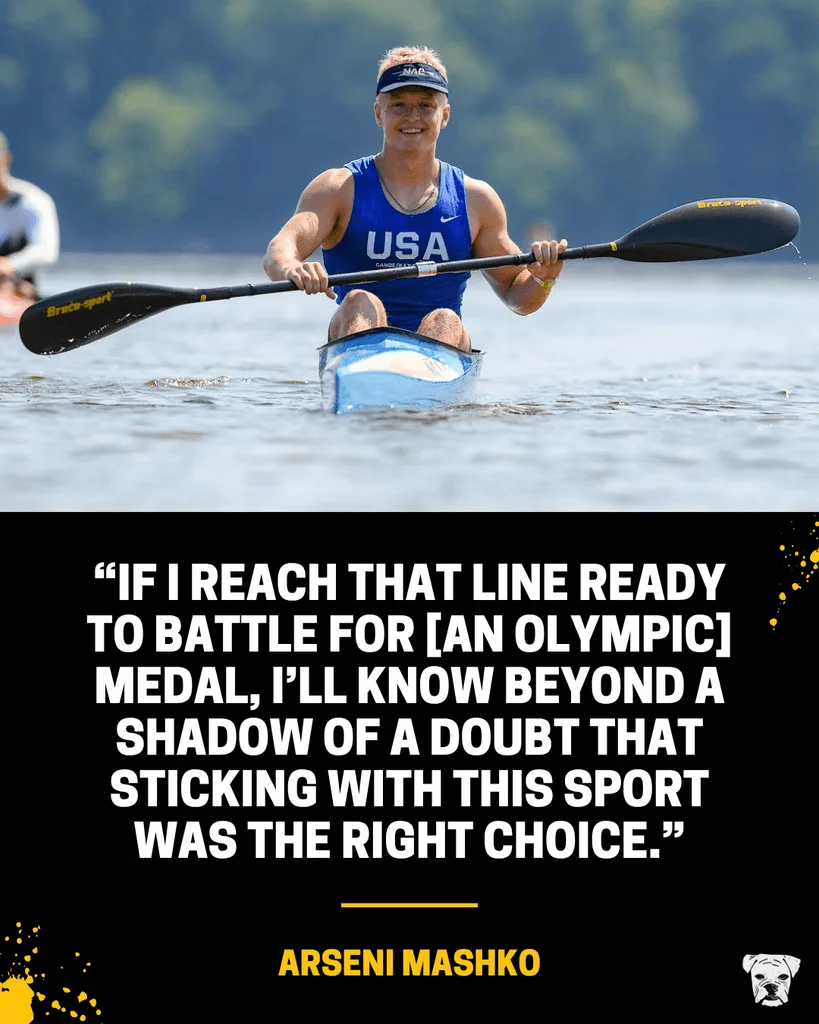
At the Sprint National Championships, Arseni had to battle more than just his rivals on the water. A heavy headwind, shifting crosswinds, a strong tidal current, and two days of relentless rain turned the sprint events into a true test of technique and stamina.
A narrow, ultra-light sprint kayak is notoriously sensitive to harsh elements: wind can slow a boat down or push it off its line, while a head-on current continuously robs it of momentum. In a race lasting under 40 seconds, there is zero margin for error and no time to recover from a lost stroke.
“In weather like that, you can’t just rely on muscling your way through. If you tense up, your technique breaks down — the boat rocks, your stroke shortens, and half your power gets wasted. It’s like sprinting into a gale-force wind: the advantage goes to whoever preserves their form and bleeds the least amount of speed. Absolute times on a day like that didn’t tell the whole story,” Mashko explains.
Despite the punishing conditions, Arseni claimed gold in the K1 200m final, beating eight other finalists with a time of 39.05 seconds. He followed that up with another gold medal performance in the K2 200m alongside partner Walker Peck, stopping the clock at 35.89 seconds.
Arseni admits that the K2 event was a major test of its own. In team boats, you can’t simply put two fast paddlers together and expect to win. Both athletes have to move in complete unison, almost like a single organism: if one person catches the water a fraction of a second early, alters the cadence, or applies force unevenly, the entire boat slows down.
“Leading up to Nationals, I trained in various crew combinations, but Walker Peck and I specifically wanted to test our synergy. Right away, we felt a natural rhythm and shared acceleration: the boat ran flat, smooth, and without any unnecessary drag. Mentally, the single boat is tougher for me because every mistake and the final result rest entirely on my shoulders. The double boat is more technically demanding because you often have to abandon your personal rhythm and adapt for the collective speed of the crew,” the young athlete notes.
With two years remaining in the U23 category, Arseni’s immediate focus is qualifying for the U23 World Championships and earning opportunities to compete on the World Cup circuit in both single and team boats, particularly the K2. Looking further down the road, his targets are the Senior World Championships and the Pan American Games.
His ultimate long-term dream, however, is even bigger: obtaining U.S. citizenship and representing the United States at the 2032 Olympic Games in Brisbane. By then, Arseni will be 27 — an age he expects to coincide with his physical and athletic peak. His ambition isn’t merely to make the Olympic roster, but to line up at the start line as a true contender capable of making the final and fighting for a medal.
“To me, that would mean infinitely more than just competing in another race. This journey started when I was ten years old in Belarus and continued when I moved to the United States, where I had to adapt to a new culture, learn a new language, get a college degree, and prove myself all over again against American paddlers. Putting on a Team USA jersey on the Olympic stage would be the ultimate validation that this country, where I’m building my life and my career, has truly become my home. It would mean that all those years of hard work, administrative roadblocks, and moments of self-doubt were worth it. And if I reach that line ready to battle for a medal, I’ll know beyond a shadow of a doubt that sticking with this sport was the right choice,” Arseni concludes.
Editor’s Note: I want to give a big thanks to Arseni for sharing his journey with our readers, and to Elizaveta for putting this story together for Joker Mag! Be sure to subscribe to our free weekly newsletter for a new underdog story every Sunday 👇