Have you ever watched an Olympic sport on TV and thought to yourself, “I could do that”?
Curtis Tomasevicz thought the same thing.
“I had joked in high school during the ‘98 Olympics that I thought I could be a bobsledder, but I didn’t put much thought into it.”
Little did he know where that joke would take him.
Growing up in Shelby, Nebraska – a town of just 707 people – Curtis was a great high school athlete who was dead set on playing football at the Air Force Academy.
But a broken collarbone derailed the opportunity. So he took an academic scholarship at the University of Nebraska, and was one of 120 kids who tried walking on to their football team.
Somehow, in a sea of talented players, he landed a spot on the Division 1 team he grew up rooting for.
What happened next led him down a path he never expected.
He ended up trying out for the U.S. bobsled team with no experience in any kind of sledding – the difference between the highest and lowest points in his hometown of Shelby is about 5 feet, making even regular sledding impossible.
Once again, Curtis defied the odds.
Not only did he make the team, but he etched his name in the history books.
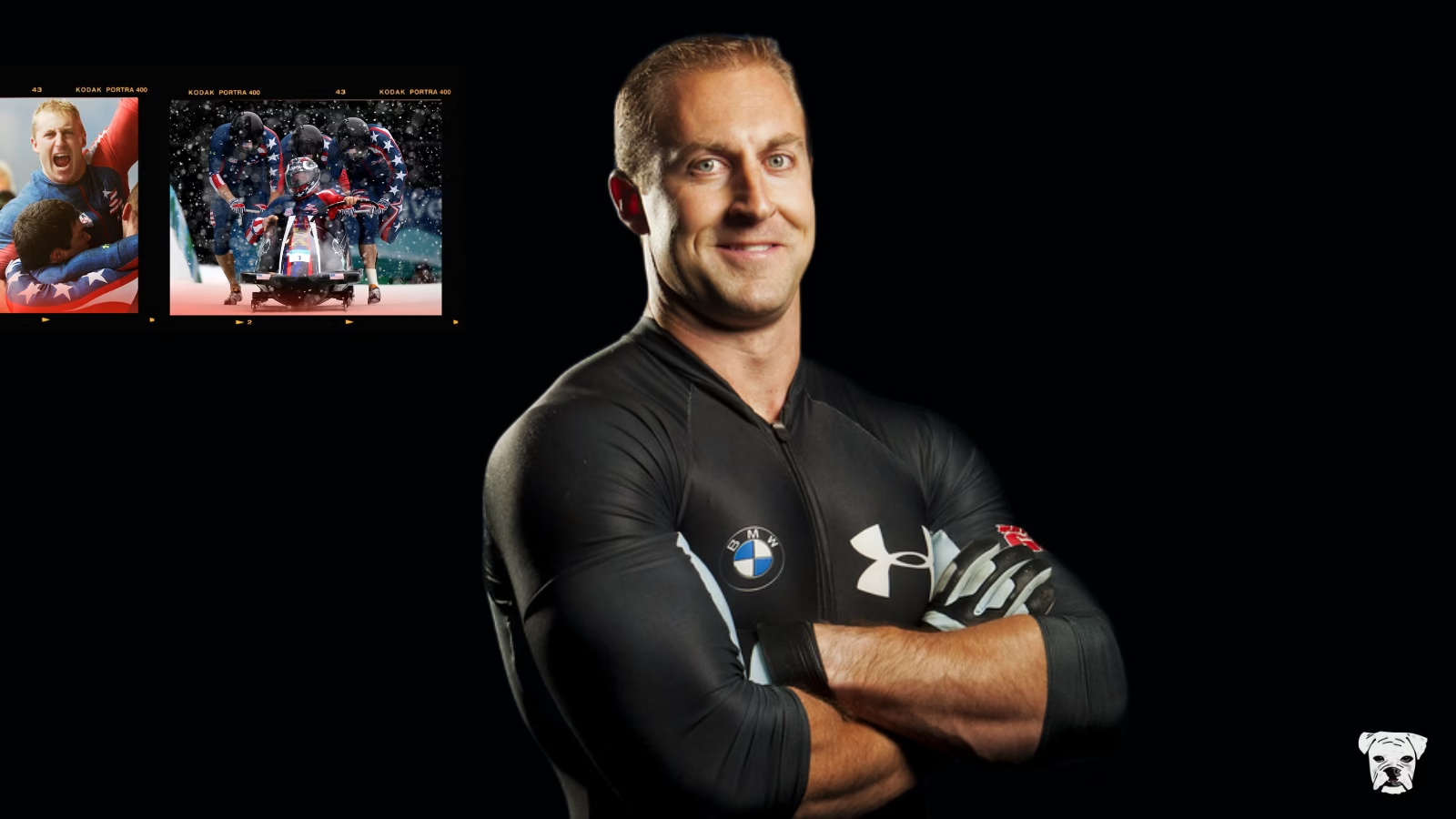
Today, Curtis Tomasevicz is an Olympic gold medalist and was recently inducted into the U.S. Olympic & Paralympic Hall of Fame.
This past week, I had the privilege of connecting with Curtis to hear the full story in his own words.
In our exclusive interview, he shared:
- How a devastating injury led to an unexpected opportunity
- The comment that changed the course of his life
- Surprising secrets of training for Olympic bobsledding

Growing up in such a small town, it must have been tough to get noticed by college programs. Tell me about what it was like to walk onto the football team at the University of Nebraska alongside 120 other aspiring walk-ons. What motivated you to take that leap, and what was the hardest part of fighting to make the team?
I had received a couple of letters when I was in high school about the potential of an invitation to walk on to the University of Nebraska, but I had, in a sense, put all my eggs in one basket.
I was planning on and committed to going to the Air Force Academy with the plan to play football there.
However, during my senior year in high school, I broke my collarbone and couldn’t pass the physical fitness test by the deadline for the Academy. And, by that time, the walk-on offer wasn’t available anymore.
Fortunately, I went to the University of Nebraska with an academic scholarship. But I wasn’t satisfied with just intramural sports, so I tried out for the football team in January of my freshman year.
With the 120 others that tried out that day, they only kept a few of us to join the team for spring ball that year.
After the spring, there were three of us left. The hardest part was joining the team below the walk-ons on the depth chart. I had to work hard to get noticed.
What was it like to play for the team you grew up rooting for and wear that “N” on your helmet?
The first game I suited up for will always be a great memory. It felt like the stadium was shaking as we took the field during the Husker Tunnel Walk (a big deal in Nebraska!).
A memory of my grandpa taking me to my first game when I was 8 years old came back to me, and l looked up to the seats where we sat.
He was a big fan who had season tickets for decades, but sadly, he passed away about a month before my first game. He was able to watch a practice during my first spring after I made the team, but he never saw me in a game uniform on the sideline of a game.
You said in an interview that you didn’t see a bobsled til you were 23 years old. How did you first get introduced to the sport, and what was it like transitioning from football to bobsledding? Were there any unexpected challenges or growing pains along the way?
One of our football strength coaches, Bryan Bailey, made a comment to me just as I was finishing my senior season on the football team that he was training a girl on the track team for a tryout with the U.S. bobsled team.
That got my attention.
So, after I was done with football and working on my master’s degree, still at the U of Nebraska, I kept training with Bryan and soon met Amanda Moreley. She convinced me to try out for the team as well.
I had joked in high school during the ‘98 Olympics that I thought I could be a bobsledder, but I didn’t put much thought into it.
Being from Nebraska, the only sledding we did was with a saucer sled tied with a 40’ rope to a four-wheeler.

You once said that bobsledding “kind of looks like you’re going for a smooth roller-coaster ride, but it’s very violent because you get bounced off the hard ice and off the walls, so it can really jolt your body and your back.” For fans who are unfamiliar, can you give us an overview of what it takes to train and compete in bobsledding at the Olympic level? Any nuances of the sport that might surprise people?
In the off-season, the training for bobsled is all about creating power.
So, we focus on the combination of strength and speed. We train half the time in the weight room with workouts that consist mostly of squats, cleans, and deadlifts. And then we train on the sprint track, doing short sprints rarely more than 50 meters. We also do a lot of plyometrics, jumps, and bounds to create the explosiveness that it takes to push a 450-pound sled.
During the season, we continue the physical training in addition to practice and trips down the track. We are very limited with the actual number of times we can go down the track due to the season, ice time, weather, and just the neurological toll that being in a sled takes.
In my entire ten-year career, I probably had about 1,000 runs total (100 trips/season).
It’s very rough on the body. Not just because of the ice conditions and the simplistic elements of a sled, but also because a brakeman rides in an aerodynamic position that can make your back and core vulnerable to injury.
Overall, I was very fortunate to have minimal injuries while competing.
You qualified for three Olympics (2006, 2010, 2014) and earned gold in Vancouver (2010) and silver in Sochi (2014). What was it like to compete on an international stage in front of millions? And how did it compare to playing football in front of 85,000 at Memorial Stadium?
Competing at the Olympics was very different than competing in Memorial Stadium.
While there may not be the same number of screaming fans at the event, knowing that there are billions of people who watch the Olympics brings it to another level.
I remember my first World Cup race and realizing that I was competing against athletes from many other countries. It opened my eyes to the fact that we were representing the entire nation when we competed. I never took that for granted.
Wearing “USA” on our speedsuits and all the red, white, and blue apparel is an honor.
Along the way, there must have been moments where the odds felt stacked against you. What kept you going during those times, and what advice would you give to someone chasing a dream down an unconventional path?
I feel like I have always performed better with a bit of a chip on my shoulder.
When I was in high school, I felt like I was snubbed by a basketball all-star team. I got very little recognition from colleges for scholarship offers. I had to work extra hard to earn playing time at Nebraska despite great testing numbers.
Even during my first two years in bobsled, I wasn’t on USA 1, even though I had the best individual pushing numbers. All of those moments motivated me to prove to people that I could be the best.
I wasn’t a vocal athlete, and I think that forced me to have to do more on the field or ice to get noticed and eventually earn accolades.
On top of that, I feel that the USA bobsled team is always an underdog.
Despite being one of the largest and athletic countries in the world, not many people bobsled. So, when we compete against countries like Germany, Austria, and Switzerland, where bobsled has a huge following, I think it drove our team in 2010 and 2014 to win an Olympic medal.
Thank you for your time! How can our readers support you, your work, or any causes you care about?
I appreciate the invitation to share my story!
Editor’s Note: A big thanks to Curt for sharing his story with me, and to Underdog Newsletter subscriber Lester Gabriel for making this interview happen!
You can read more about Curt’s impressive work as a professor at the University of Nebraska here.