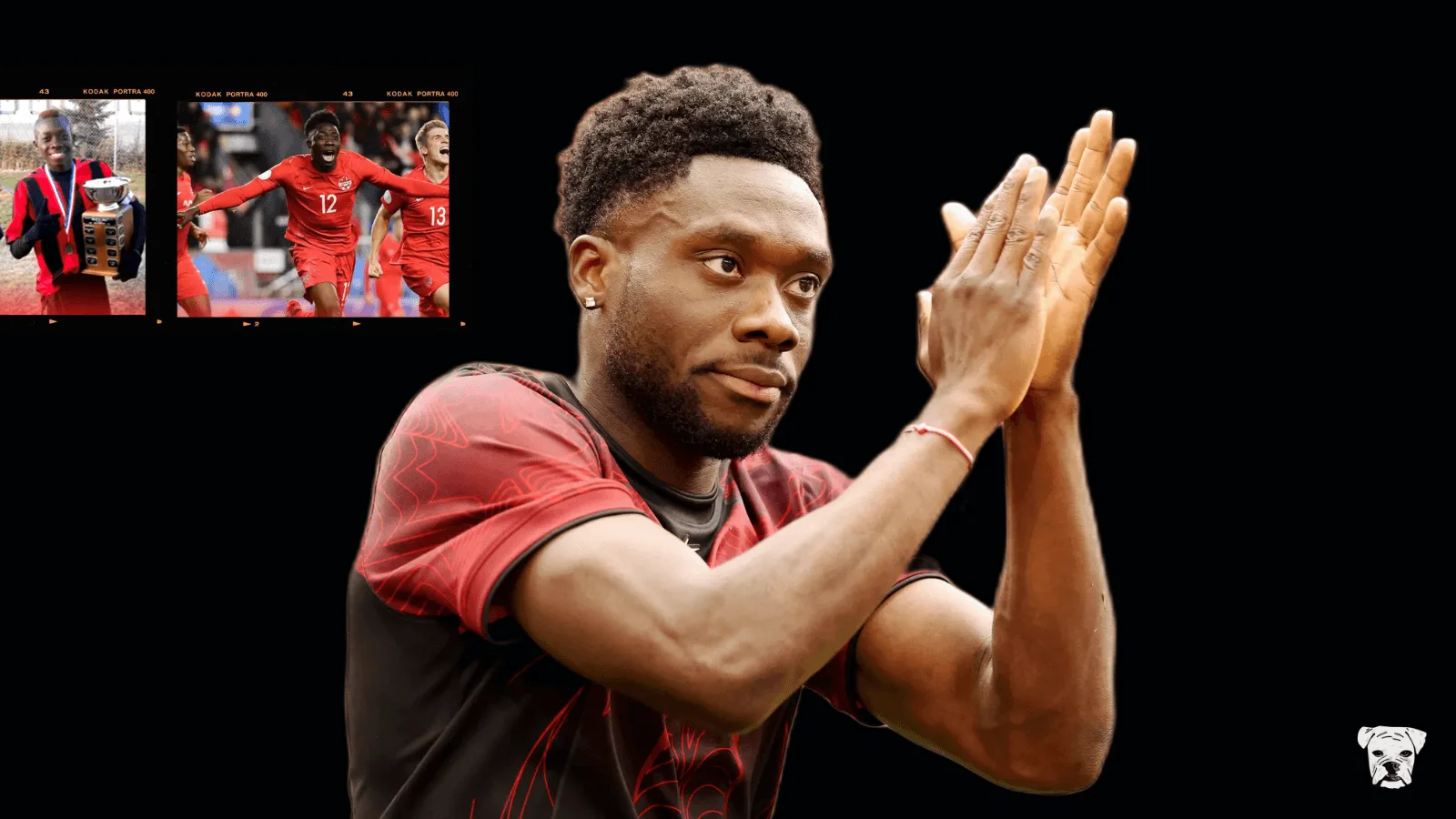
At the age of five, he arrived in Canada with basically nothing but the clothes on his back and whatever his parents could carry out of a war-torn Buduburam, Ghana.
Now just 25 years old, that same tiny, wide-eyed boy has become the face of Canadian soccer, helping to bring the 2026 World Cup to North American soil.
Alphonso Davies was born on November 2nd, 2000, in the Buduburam refugee camp in Ghana.
The fourth-youngest of Debeah and Victoria’s six children, Alphonso spent his first five years living amid the Second Liberian Civil War, a conflict that claimed over 250,000 casualties.
His family lived in a clapboard hut “not much larger than a minivan.”
They struggled for clean water, food, and basic safety, grinding through camp life with little guarantee of what would come the next day.
At times, they had to climb over corpses to find food.
Per UNHCR, less than 1% of the world’s refugees are resettled every year.
“The rest either have to remain in the country of asylum, which isn’t always an ideal long-term solution,” said author Farhan Devji.
“Or they have to return home, where they may still be at risk from the reasons that forced them to flee in the first place. So, when you think about it, Alphonso and his family were among the lucky ones.”
When Davies was five, his family was finally granted refugee status and relocated to Edmonton, Alberta, Canada. Not only was this a geographical change, but a cultural one as well.
Of all the places in the world, Edmonton doesn’t exactly scream soccer as much as it does hockey or even Canadian football. Yet it was at St. Nicholas Catholic Elementary that Davies began to fall in love with the game, kicking the ball around with his friends.
“I didn’t have boots, no real jersey, but I was so happy,” Alphonso said.
It was clear from the start that there was something special about him compared to his peers. He was faster, he had more natural talent, and he showed more joy each time he took the field.
It wouldn’t be long until Davies found himself joining Free Footie, a local youth soccer program for underprivileged kids.
His skillset immediately captured the attention of program founder Tim Adams, who reached out to Marco Bossio, the head of The St. Nicholas Soccer Academy.
“There was something special about this boy,” Bossio said.
“He had lightning-quick feet and speed with the ball. I knew that was something special at that age. I asked him what his plans were, and he told me he would be playing with us next season. We were delighted.”
But Davies himself saw things differently.
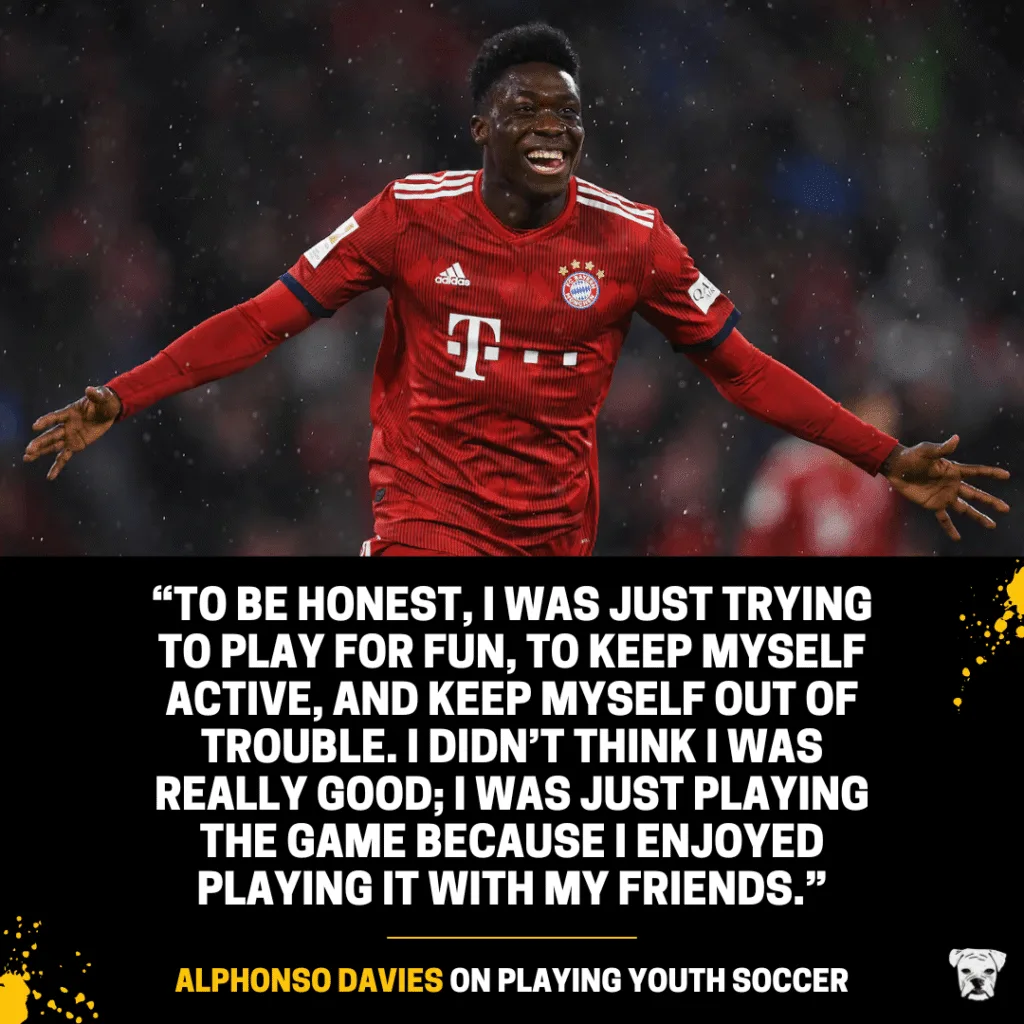
“To be honest, I was just trying to play for fun, to keep myself active, and keep myself out of trouble,” he admitted.
“I didn’t think I was really good; I was just playing the game because I enjoyed playing it with my friends. Then once I started playing organized soccer, parents, coaches, and other teammates were telling me to keep going, and that I could become something, so I started believing it.”
Playing with the Edmonton Strikers Soccer Club, Davies’ natural abilities and skills made him a standout at every age group, and by the time he turned 14, he had captured the attention of the Vancouver Whitecaps FC of the MLS, which presented him with the opportunity to take part in their residency program.
This meant that Davies had to leave his family, friends, and everything familiar and safe in Edmonton to start fresh 700 miles away in Vancouver.
Moving to the West Coast, Davies lived with a host family, attending high school in the morning, with soccer becoming a full-time part of his afternoon and evening schedule.
One year after arriving in Vancouver, Davies, at the age of 15 years, 8 months, and 15 days, became the youngest player in Whitecaps team history to play with the first team. At the time, he was the second youngest player in league history to make his debut.
“For me, he’s a little bit of an anomaly. When he came in, he was part of the U16 team, and within months, he went from U16 to U18, WFC2 to the senior team. That’s very rare that happens, and it’s very rare that it will happen that much in the future,” said then-Whitecaps president Bob Lenarduzzi.
Davies was far more than an anomaly; he quickly became a star.
With a combination of speed, skill, passion, and work ethic that was far more mature than his age, he dominated the wing position, earning an MLS All-Star, the Vancouver Whitecaps Player of the Year, and the Canadian Men’s Player of the Year all by the age of 17.
Within a span of two and a half seasons, Davies appeared in 65 MLS games, recording 8 goals and 12 assists, playing his way out of the MLS and on to bigger and better things.
After drawing interest from multiple European clubs during his time in Vancouver, in June 2018, Davies was transferred to FC Bayern Munich for what at the time was a record-breaking deal worth up to $22 million USD, the most ever paid for an outgoing MLS player.
Instantly, he went from a promising North American teenage soccer player to one of the most expensive young players in European football.
The move represented both an incredible opportunity and an enormous challenge. Bayern Munich is not simply another European club; it is one of the most successful soccer clubs in the world.
For a teenager who had arrived in Canada as a refugee little more than a decade earlier, the transition was obviously intimidating.
But, just as he had done many times before, Davies embraced the opportunity with the same confidence and relentless work ethic that he had become known for.
Bayern’s coaches quickly recognized that his athletic gifts were unlike anything they had seen before. While he arrived in Munich as an attacking winger, Bayern’s coaching staff soon discovered that his pace, recovery speed, and attacking instincts could make him equally dangerous in a defensive role.
Many elite athletes would have challenged their coach and voiced their opinion on having to change positions, but the switch to left back transformed Davies from an exciting prospect into one of the most electrifying players in the game. During the 2019-20 season, he became a key piece of a Bayern team that captured the Bundesliga title, the DFB-Pokal, and the UEFA Champions League, completing a historic continental treble.
His rise at Bayern was remarkable not only because of his talent, but because of how quickly he earned the respect of some of the biggest stars in the sport. Surrounded by veterans who had won World Cups and Champions League titles, the Canadian teenager never looked out of place.
His performances during Bayern’s 2020 Champions League run elevated him to global stardom.
Fans around the world marveled at his ability to erase opposing attacks with breathtaking recovery runs and then immediately launch dangerous counterattacks of his own. Suddenly, the kid from Edmonton had become one of the most recognizable players in international soccer.
Despite the fame and success, Davies never forgot where his story began, frequently speaking about the opportunities Canada provided his family after they fled Liberia’s civil war and spent years in a refugee camp in Ghana.
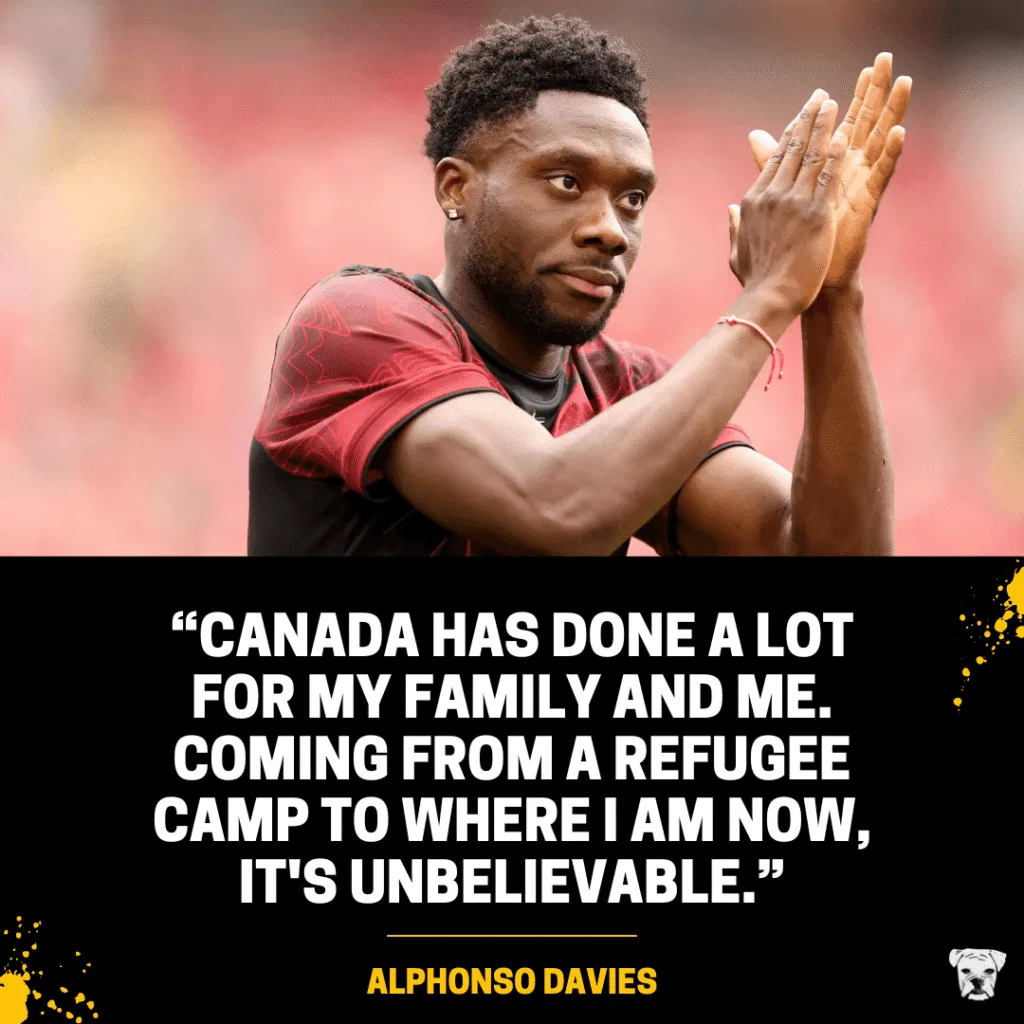
“Canada has done a lot for my family and me. Coming from a refugee camp to where I am now, it’s unbelievable.”
But those weren’t just words for the cameras and the mics.
In November 2022, before Canada took to the pitch for their first World Cup match in 36 years, Davies posted a raw, authentic message that captured the hearts of even the most casual fan:
“A kid born in a refugee camp wasn’t supposed to make it. But here we are GOING TO THE WORLD CUP. Don’t let no one tell you that your dreams are unrealistic. KEEP DREAMING. KEEP ACHIEVING.”
Just 67 seconds into Canada’s second group stage match against Croatia, Davies directed a Tajon Buchanan cross with a leaping header and put it in the net, scoring Canada’s first-ever goal at a men’s World Cup.
The country lost that match 4-1 and exited the group stage without a win, but something had changed. Davies had written himself into Canadian sports history, and the goal gave an entire generation of young Canadian kids something to look forward to.
Coach John Herdman said it best following the tournament, “They’ve seen Davies score against Croatia, and they know we are, I nearly said it, yeah, we’re a football country. We’re there. And you can’t deny that. No one can.”
Four years later, Davies has found himself as the unofficial host of the Canadian component of the 2026 World Cup.
Just eight years ago, a 17-year-old Davies, complete with braces on his teeth, found himself standing in front of over 200 FIFA officials and a worldwide audience delivering a speech for North America to host the tournament.
“My name is Alphonso Davies,” he told the delegates, his teenage voice cracking with nerves and confidence at the same time.
“My parents are from Liberia and fled the civil war. It was a hard life, but when I was five years old, a country called Canada welcomed us in, and the boys on the football team made me feel at home. My dream is to someday compete in the World Cup. The people of North America have always welcomed me, and if given the opportunity, I know they’ll welcome you.”
A journey that started in a refugee camp in Ghana, passed through Edmonton and Vancouver, travelled back overseas to Munich, and has made its way back to Canadian soil.
A home World Cup. A Canadian crowd. And the face of the whole thing is a 25-year-old man who stood in front of the world at 17, braces on his teeth, and told them his dream was to someday compete in the World Cup.
That dream is here. And so is he.
“I’m so grateful to my parents. Life wasn’t easy back then, but my parents brought our family to a safe country. If they had not had the courage to leave Africa, I would never have been a pro footballer.”